On foot · 2026
Running glasses that stay put.
Running is three impacts a second for an hour or more, in your own sweat, in air you are moving through fast enough to matter. It punishes anything loose, anything heavy, and anything sealed. Here is what smart glasses genuinely add to a run — and why the frame that looks the most like running gear is not always the one a runner should buy.
Still deciding? Get the M02C, M08 and M08C comparison in your inbox, with your new-customer price already applied.
One email with the comparison, one follow-up a few days later. Unsubscribe any time.
Five things a stride does to a pair of glasses
Running is not walking faster. It loads eyewear in a specific, repetitive way, and the five consequences below are what actually decide whether you keep wearing a pair after week three.
- Bounce. Three impacts a second, transmitted straight through the nose bridge.
- Sweat, which attacks grip before it attacks electronics.
- Fogging, worst in the ten seconds after you stop.
- Weight over hours — a number nobody notices in a shop and everybody notices at 90 minutes.
- Battery measured against a long run, where the specification most people skim is the one that matters.
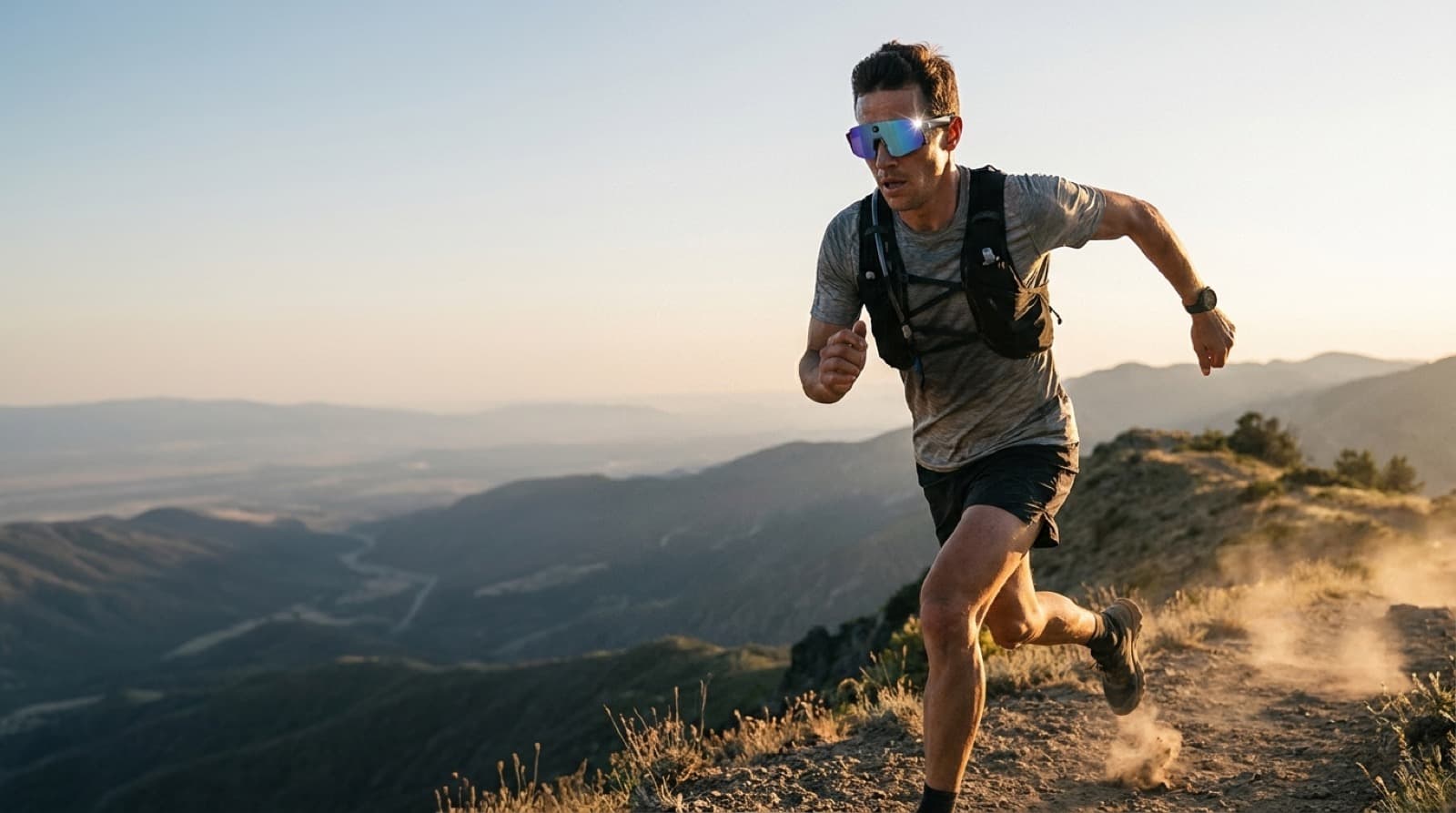
1. Bounce and grip — geometry beats grams
At a normal running cadence of about 170–180 steps a minute, your head rises and falls several centimetres every stride. Each of those cycles loads and then unloads whatever is sitting on your nose, roughly three times a second, for the length of the run. Nothing stays put through inertia; it stays put through friction at the nose pads and light lateral pressure from the temple arms.
Which is why frame geometry decides more than mass. The M14’s PC temple arms run straight and flat along the side of the head — pressure distributed along a length of skull rather than concentrated on the hook behind one ear. The M08 family’s round TR90 frames hook behind the ear in the traditional way, which is more comfortable at a desk and less secure at pace.
Then sweat arrives and undoes the friction half of the equation. Every runner reseats their glasses; the question is whether it is twice an hour or every kilometre. If you are a heavy sweater and this is your main worry, a wrap is the safer bet.
2. Weight, told honestly
A dedicated running sunglass with no electronics in it weighs 22–30 g. Nothing with a camera, two speakers, three microphones and a 300 mAh battery gets near that. Ours:
- M02C — ~41 g, the lightest camera frame in the line
- M08 / M08C — ~42 g
- M14 — 52 g, the wrap
Under an hour, most runners stop registering any of them. The gap opens up on long runs: 10 extra grams on the bridge for two hours is a real, if small, tax, and it is the reason the “obvious” sports frame is not the automatic pick for marathon training. If you run mostly on roads in daylight and want the least frame you can feel, the M02C is the one.
3. Sweat and the IPX4 line
The M14 is IPX4: sweat and splashing water from any direction, rain included. That is the correct rating for running and it is not waterproof — no submersion, no holding them under a tap, and definitely not the washing machine with your kit.
Sweat is the more damaging of the two because it is salty. It dries into the slide-touch surface and onto the charging contacts, and over a season that is what degrades the touch response people blame on firmware. The maintenance is thirty seconds: damp cloth after a hot run, dry before charging. The M02C at $159 carries IP65, the highest seal in the line, if you run in genuinely wet weather year-round.
4. Fogging — and why a shield behaves differently
Fog forms when the lens is cooler than the humid air against it, which on a run means two moments: a still, humid morning, and every time you stop moving. A one-piece wrap shield sits closer to the face and traps more warm, wet air behind it than an open round frame — so it fogs a bit more eagerly at a crossing, and clears a bit faster once you are moving again and air is passing across it.
There is no clever fix in a spec sheet. Push them onto your forehead at the light. Runners who hate that behaviour more than they want coverage should look at the round frames, which breathe more simply because there is more open air around the lens.
5. The battery split that should change which frame you buy
This is the most useful paragraph on the page, and it argues against the frame that looks the part.
The M14 runs its 300 mAh cell at 4 hours of listening and 7 hours of calls. The entire M08 family — M08, M02C, M08C — runs the inverse: 7 hours of listening and 4 hours of calls. Both charge in about 2 hours.
Now ask what you do on a run. Almost nobody takes calls while running; almost everybody listens to something. The M14’s call-biased battery is tuned for a rider taking dispatch calls or a traveller on a long day, not for a runner with a podcast. Against a marathon block — a 2:30 long run, then another the following week — 7 hours of listening from a $149 M08 is materially better than 4 from a $199 wrap, at 10 g less.
So who is the M14 for on foot?Trail and speed. When you want coverage against wind, grit and low sun from the side, when you want the fixed shield’s taller lens, or when you want 4 GB of onboard memory and stabilised 1080p from a Sony IMX219 for the descent. That is a real set of reasons — it is just not “the battery.”
6. Capture mid-stride
A slide-touch on the temple arm starts a photo or a clip: about a second of one hand leaving your arm swing, against ten seconds of digging a phone out of an armband, unlocking it and shooting one-handed while your cadence falls apart. That is the whole argument, and on a run it is stronger than in almost any other activity because the phone is the most awkward it ever gets.
Set expectations on the output. You are aiming your head. It is excellent for a finish chute, a ridge, a training partner in front of you, the first light on a road you run every week. It is useless for anything that needs framing. The M14 shoots 8 MP stills and 1080p 30 fps with electronic stabilisation — and EIS earns its keep here, because a running stride is exactly the periodic vertical shake it was designed to remove.
7. Open ears, traffic and race rules
Open-ear directional drivers sit above the ear and leave the canal completely open. On a road at 6am, that is a safety feature and not a compromise: you hear the car, the cyclist coming past, the dog before you see it. There is no sealed or in-canal option anywhere in the OXIVUE line.
For events: many race organisers restrict or discourage headphones on open-road courses, and policies differ between governing bodies and individual races. Open-ear audio is usually the accepted compromise where earbuds are not — but it is not automatically exempt anywhere. Read the specific race’s rulebook, especially for chip-timed competitive events. We are not offering a ruling, only telling you where to look.
Requirement → capability → frame
| On a run | What it needs | Frame |
|---|---|---|
| Hear traffic and other runners | Open-ear directional, nothing in the canal | Every OXIVUE frame |
| Long runs, mostly listening | Listening-biased battery | M08 $149 / M02C $159 — 7 h listening |
| Least weight on the bridge | Grams | M02C ~41 g · M08 ~42 g · M14 52 g |
| Stays put at pace, trail and speed | Wrap geometry, straight temple arms | M14 $199 |
| Coverage from wind, grit and low sun | One-piece shield | M14 — the only wrap in the line |
| Sweat and rain | IPX4 splash rating (never submersion) | M14 · M02C is IP65 |
| Dawn start, bright finish, one pair | Photochromic lens | M08 / M02C / M08C — not the M14 |
| Capture mid-stride | Slide-touch, 8 MP, stabilised 1080p | M14 · 4 GB onboard |
| Running abroad, races overseas | Live translation (needs phone + signal) | M14 139 languages · M08 family 40+ |
| Pace, distance, heart rate | A watch | None — no sensors, no display in any lens |
What they do not do
- No pace, distance or heart rate. No GPS, no optical sensor, no display in the lens. These pair with your watch; they do not replace it.
- Not waterproof. IPX4 is sweat and rain. It is not a swim, a river crossing, or the bottom of a laundry basket.
- Translation and the AI assistant need your phone. They run through the companion app over Bluetooth 5.4 and require connectivity. Audio playback and capture keep working when the signal does not.
- Not prescription out of the box. Most runners who need correction wear contacts — the honest state of the alternative is in our prescription guide.
- Not a chest-mounted action camera. Head-pointed capture, on demand.
Which frame
- M08 — $149. The long-run pick, and the one most runners are better off with. ~42 g Italian TR90, 8 MP camera at the bridge, 7 h listening / 4 h calls, three interchangeable lenses — order photochromic if you start before sunrise and finish in daylight. Ships from Chicago, IL in 5–9 business days.
- M14 — $199. The trail and speed pick. A 52 g wrap with a fixed one-piece PC shield in four colourways, IPX4, 8 MP Sony IMX219, 1080p 30 fps with EIS, 4 GB onboard, 139-language translation, 4 h listening / 7 h calls. No interchangeable lenses — choose the colourway for your light. Ships in 9–14 business days.
- M02C — $159.The lightest camera frame at ~41 g, with the highest water rating in the line at IP65, dual stabilisation and the “Hey Cyan” visual assistant. The pick for wet-weather road running. 5–9 business days in the US.
Bottom line
If your running is long and mostly listening, buy the M08 at $149 — three more hours of audio, ten fewer grams, fifty dollars cheaper, and a photochromic lens option the wrap does not have. If your running is trail, fast, or in weather that comes at you sideways, buy the M14 at $199 for the coverage and the stabilised capture, and plan audio around four hours. Free shipping from $99, a 2-year limited warranty on both.
Related: smart glasses for cycling, where wind sets the ceiling instead of bounce; how photochromic lenses behave if you run at both ends of the day; and the under-$200 buyer’s guide for the whole line. Side by side on the comparison page.
If you arrived here from the big-brand option, the cheaper alternatives to Ray-Ban Meta breakdown covers what a sub-$200 frame keeps and what it does not.
Frequently asked questions
Do smart glasses bounce or slip when you run?
That is decided by geometry and sweat, not by weight alone. At 175 steps per minute your head rises and falls several centimetres per stride, loading and unloading the nose bridge roughly three times a second. Frames stay put through friction at the nose pads and light pressure from the temple arms; sweat destroys the first. A wrap like the OXIVUE M14, whose PC temples run flat along the side of the head, holds better than a round frame that hooks only behind the ear — but any pair will need reseating on a hot two-hour run.
Is 52 grams too heavy for running glasses?
It is noticeably more than a dedicated running sunglass, which typically lands between 22 and 30 g. The M14 is 52 g and the M08 family around 41–42 g, because a camera, speakers, mics and a 300 mAh cell have to live somewhere. Under an hour, most runners stop registering it. Over two hours, on a hot day, a heavier frame is the thing that reminds you it is there. If weight is your first concern, the 41 g M02C is the lightest camera frame we make.
Are running smart glasses sweatproof?
The M14 is IPX4 — rated for sweat and splashing water from any direction, including rain. It is not waterproof: no submersion, no rinsing under a tap at pressure, and never in a washing machine. Sweat matters more than rain here because it is salty and it dries into the touch surface and the charging contacts. Wipe the frame with a damp cloth after a hot run and let it dry before you charge it.
Do smart glasses fog up when running?
They can, in the same conditions any sunglass does: humid mornings, and the moment you stop at a crossing when the airflow that was clearing the lens disappears. A one-piece wrap shield sits closer to the face and traps more of that warm air than an open round frame does, so it fogs a little more readily when you stop and clears a little faster when you move. The practical trick is the same as always — push them up onto your forehead at a light rather than waiting them out.
How long does the battery last for a long run?
This is where the model choice flips. The M14 at $199 runs 4 hours of listening and 7 hours of calls. The M08 family — M08, M02C, M08C — inverts it to 7 hours of listening and 4 of calls. Runners overwhelmingly listen rather than talk, so the $149 M08 gives you three more hours of the thing you actually use, and does it about 10 g lighter, even though the M14 is the frame that looks like running gear.
Can you take a photo while running?
Yes, with a slide-touch on the temple arm — about a second of one hand leaving your arm swing, which is far less disruptive than a phone out of an armband. What you cannot do is frame the shot. You are pointing your head. It works for a finish chute, a summit, a training partner, a trail you want to remember; it does not work for anything that requires composition.
Are headphones or audio glasses allowed in races?
Policies vary by event and by governing body, and several race organisers restrict or discourage headphones for safety on open-road courses. Open-ear directional audio leaves the ear canal completely unobstructed, which is why it is usually the accepted compromise where earbuds are not — but it is not automatically exempt. Read the specific race's rulebook rather than assuming, particularly for anything chip-timed and competitive.
Do OXIVUE glasses track pace, distance or heart rate?
No. There is no GPS, no heart-rate sensor, no accelerometer-based pace estimate and no display in the lens on any OXIVUE frame. Your watch keeps its job. These are a camera, open-ear speakers, microphones and a translation engine.
Which OXIVUE model is best for running?
Two honest answers depending on your runs. For long, mostly-listening miles: the M08 at $149 — 7 hours of listening, about 42 g, and three interchangeable lenses including photochromic. For trail, speed and coverage against wind and grit: the M14 at $199 — a 52 g wrap with a fixed one-piece shield, IPX4, 8 MP Sony IMX219 capture and 139-language translation. The M02C at $159 sits between them at 41 g with an IP65 rating.