On the bike · 2026
Cycling glasses that also see.
A bike sets conditions nothing else does: 20 mph of wind straight into the microphone, sweat that never stops, a helmet strap running exactly where the temple arm wants to be, and two hands that shouldn't leave the bars. Here's what smart glasses solve on a ride, and the speed at which one of their headline features stops working.
Still deciding? Get the M02C, M08 and M08C comparison in your inbox, with your new-customer price already applied.
One email with the comparison, one follow-up a few days later. Unsubscribe any time.
What a bike asks that a pavement doesn’t
Most smart-glasses reviews are written by someone walking around a city. A bike changes four of the assumptions underneath them, and each one has a section below:
- Wind, which is the real limit on open-ear audio — and it arrives sooner than anybody advertises.
- Sweat and road spray, where the difference between IPX4 and “waterproof” is the whole story.
- A helmet, whose retention straps land on the same square centimetre as your temple arms.
- Hands that belong on the bars, which rules out every interaction that involves a phone.
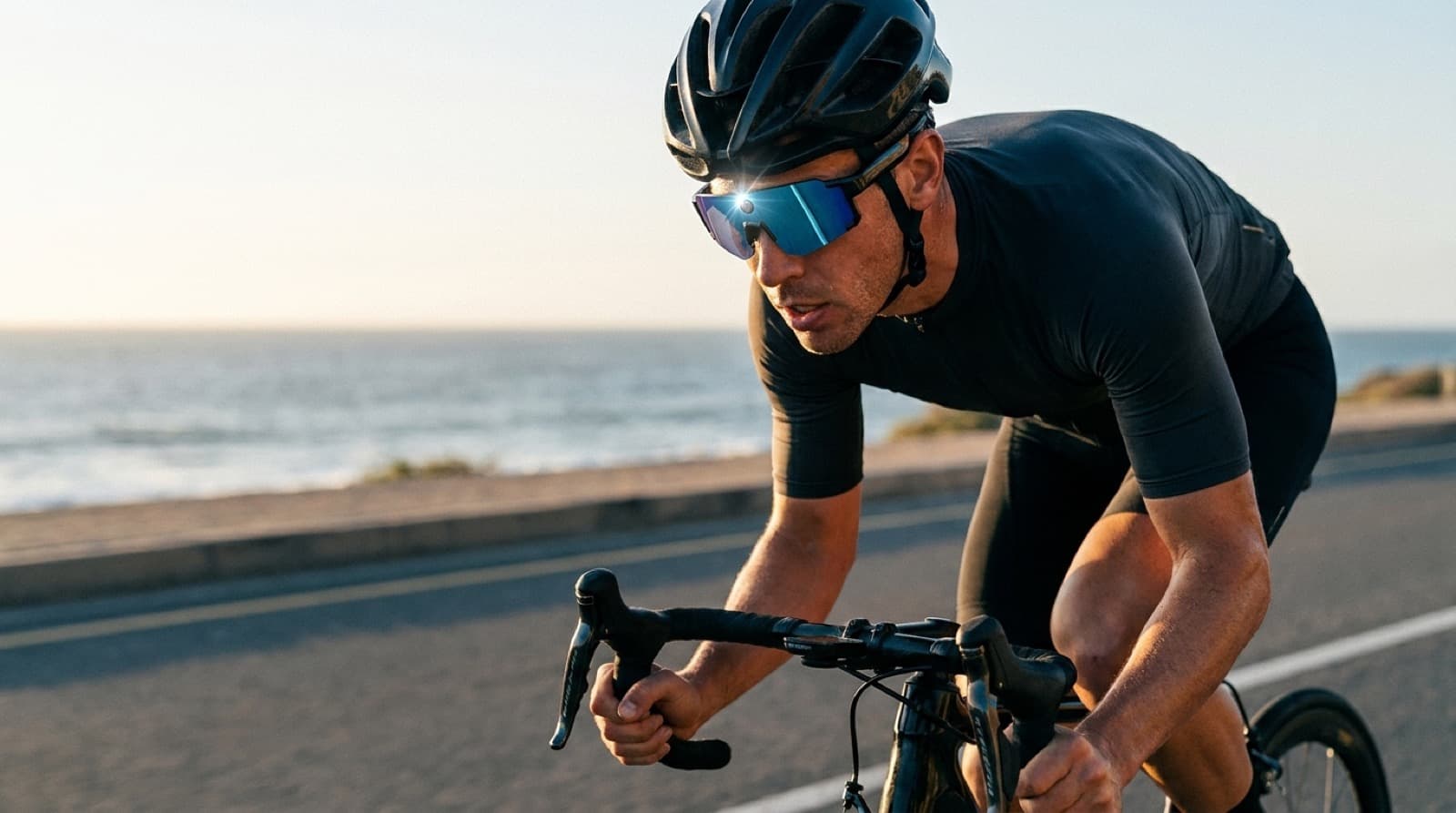
1. Wind — where open-ear audio actually stops working
Open-ear drivers sit above the ear and beam sound down into it, leaving the canal open. On a bike that is the only sane format: you need to hear the car behind you, the rider calling a hole, the derailleur that just started ticking. Nobody sensible rides with sealed buds in both ears.
But there is a ceiling, and honest cycling copy should name it. Somewhere around 15–18 mph on a calm day, air turbulence around the ear and the frame starts raising the noise floor faster than volume can chase it. Add a headwind and that number drops. On a 35 mph descent you are listening to weather, not music, whatever brand is written on the temple. This is physics, not a product flaw — an open-ear speaker has no seal to work against, which is exactly the property that makes it safe on a road.
What survives wind is the outbound direction, and that is worth understanding because it is where the M14 does something specific. Alongside two noise-cancelling microphones it carries a bone-conduction mic, which reads the vibration of your own speech through the cheekbone rather than sampling the air in front of your mouth. Wind noise lives in the air path. Your voice does not have to. The practical result: on a windy ride the person you called still hears you clearly while you are straining to hear them.
Practical setting: put audio on before the climb, not the descent. Riders who use these for calls tend to take them on the way out and on the flat, and let the descent be quiet — which is what you want anyway.
2. Sweat and rain — read the rating literally
The M14 is rated IPX4. That means splashing water from any direction: rain, road spray off the front wheel, a bidon emptied over your head at the top of a climb, and the sweat that runs down your temples for the whole of a summer ride. It does not mean waterproof. No submersion, no pressure washer, nothing left sitting in standing water.
The unglamorous part: sweat is more corrosive than rain because it is salty, and it dries into the touch surface and the charging contacts. Wipe the frame down with a damp cloth after a hot ride and let it dry before charging. That single habit is worth more than any IP number.
If your riding is genuinely wet — winter commuting in the rain, most days — the M02C at $159 carries an IP65 rating, the highest in the line, though it is a round everyday frame rather than a shield. That is a real trade: better sealing, much less coverage. See the full comparison if you are weighing the two.
3. Helmet, temple arms, and the order you put them on
Every cyclist has done this: helmet on, glasses on, and now the arm of the glasses is trapped under the strap splitter behind the ear, so removing one means loosening the other. The fix is an order of operations, not a product feature — helmet first, then glasses over the straps. You can take them off at a café or push them up into the vents without unbuckling anything.
Frame shape decides how well that works. The M14 is a 150 × 56 × 169 mmwrap with straight PC temple arms — they run flat along the side of the head, so the strap splitter sits above or below them rather than fighting them. The M08 family’s round TR90 frames have a curved temple tip designed to hook behind the ear, which is comfortable at a desk and awkward under a retention system. If you ride in a helmet more than occasionally, that alone points you at the wrap.
4. Why a shield, and what the drops do to your sightline
The strongest argument for a wrap on a bike has nothing to do with looking fast. When you drop into the hoods or the drops, your head goes down and your eyes go up — you are looking at the road through the top third of the lens. A conventional frame puts a rim exactly there. You end up reading the road through a horizontal bar, or you tilt your head further back to see over it, which is the neck ache nobody attributes to their glasses.
A one-piece shield has no top rim and a taller lens, so the useful field stays clear in a low position. It also wraps far enough round to keep crosswind grit, insects and spray off the eye from the side, which a round frame simply does not do at 20 mph.
The cost of that shield is that it is fixed. The M14 has no interchangeable lenses — you choose one of four colourways and that is the lens you own: Nero (black frame, smoke), Azzurro (black frame, blue mirror), Ghiaccio (white frame, ice-blue mirror) or Tramonto (white frame, sunset-red mirror). Pick for the light you ride in most. If you routinely start before sunrise and finish in full sun, a fixed tint is the wrong tool and you want a photochromic lens on an M08-family frame instead — a genuine trade of coverage for adaptability.
5. Capture without taking a hand off the bars for long
The honest version of the hands-free claim: one hand leaves the bar for about a second. A slide-touch on the temple arm starts a photo or a clip. Compare that with the phone in your jersey pocket — reach behind, unzip, pull out, wake, swipe to camera, aim, shoot, put it back — all of it one-handed at speed. That is the real comparison, and it is not close.
What you give up is framing. You point your head, not a viewfinder. The M14 shoots 8 MP stills and 1080p 30 fps video with electronic stabilisation from a Sony IMX219 sensor at the bridge, and stabilisation matters more on a bike than anywhere else — road buzz through the fork and stem is exactly the high-frequency vibration EIS was built to eat. It is a first-person record of a ride, not a substitute for a dedicated action camera on a chest mount.
4 GB of onboard memory is quietly the most useful spec here. Clips land on the glasses whether or not your phone is awake in a back pocket, and transfer over Wi-Fi when you get home. You do not have to babysit a Bluetooth connection while riding.
6. Battery against the length of your ride
The M14 runs a 300 mAh cell rated 4 hours of listening and 7 hours of calls, charging in about 2 hours. Note the direction of that split, because it is the reverse of the rest of the range: the M08, M02C and M08C all do 7 h listening / 4 h calls. The sports frame is the call-biased one.
Mapped to actual rides: an hour commute each way, a three-hour club ride, a two-hour chaingang — all comfortably inside it. A five-hour gravel day of continuous audio is not, and no frame at this price is. Treat audio as something you switch on for stretches rather than a background you leave running, and the number stops mattering.
7. Audio on a bike and the law
Riding with sound in your ears is regulated unevenly across the US. A handful of states restrict headphones or earphones in both ears while riding a bicycle, more restrict it for anyone operating a vehicle on a public road, and city ordinances add a third layer. Open-ear directional audio leaves the canal completely unobstructed, which is why riders choose it and why it is generally the defensible format — but “open-ear” is not a legal category anywhere. Read your state’s wording before assuming the format exempts you.
Recording is a separate question from listening. Consent rules for audio recording vary state to state and apply the moment you hit capture with someone else in frame — the detail is in our guide to smart glasses recording laws by state. This is not legal advice.
Requirement → capability → frame
| On the bike | What it needs | Frame |
|---|---|---|
| Hear traffic and the wheel behind you | Open-ear directional, nothing in the canal | Every OXIVUE frame |
| Be heard on a call in a headwind | Bone-conduction mic + dual-mic ENC | M14 $199 |
| Clear sightline from the drops | No top rim, tall one-piece lens | M14 — the only wrap in the line |
| Grit and spray off the side of the eye | Wrap coverage | M14 |
| Sweat and rain | IPX4 splash rating (never submersion) | M14 · M02C is IP65 |
| Wet-weather commuting, round frame fine | Highest seal in the line | M02C $159 — IP65 |
| Fits under a helmet retention system | Straight temple arms | M14 (round frames fight the strap) |
| Capture with hands near the bars | Slide-touch on the temple, 8 MP, EIS | M14 · 1080p 30 fps, 4 GB onboard |
| Dawn starts and midday sun in one pair | Photochromic lens | M08 $149 / M02C $159 — not the M14 |
| Riding or racing abroad | Live translation (needs phone + signal) | M14 139 languages · M08 family 40+ |
| Speed, power, navigation | A head unit | None — no display in any OXIVUE lens |
What these do not do on a bike
- No display, no data. No speed, no power, no heart rate, no turn-by-turn in the lens. Your head unit is not being replaced.
- Not a rear-facing safety camera. Continuous-loop rear radar cameras are a different product. The M14 records where your head is pointing, when you tell it to.
- Not prescription. Riders who need correction wear contacts under a shield — see the prescription guide for the honest state of that.
- Translation and the AI assistant need your phone. They run through the companion app over Bluetooth 5.4 and need connectivity. On a col with no bars, capture and audio playback still work; the language engine does not.
- Not waterproof. Worth repeating in the section where you were hoping otherwise.
Which frame
- M14 — $199. The cycling answer, and the only wrap we make. 52 g, TR90 frame with PC temples and a one-piece PC shield, IPX4, 8 MP Sony IMX219, 1080p 30 fps with EIS, 4 GB onboard, 139-language translation, 4 h listening / 7 h calls. Four fixed colourways, no lens swapping. Ships in 9–14 business days.
- M02C — $159.The commuter’s alternative: ~41 g, IP65 — the best sealing in the line — with photochromic, sun or clear lenses, dual stabilisation and the “Hey Cyan” visual assistant. A round frame, so far less coverage at speed. Ships from Chicago, IL in 5–9 business days.
- M08 — $149. The cheapest way in, ~42 g, 7 h of listening, three interchangeable lenses. Fine on a bike path, wrong for a fast group ride. 5–9 business days in the US.
Bottom line
Buy the M14 at $199 if you want a shield you were going to wear anyway that also captures the ride and takes a call — and buy it knowing that wind wins above about 18 mph, that IPX4 means sweat and rain rather than waterproof, and that the shield you choose is the one you keep. If your riding is wet commuting rather than fast group work, the M02C at $159 and its IP65 rating is the better object. Both carry free shipping from $99, a 2-year limited warranty against defects.
Next: the same analysis for running, where the battery split argues for a different frame entirely, and the sports-wrap alternatives comparison if you are cross-shopping the category. Every frame side by side on the comparison page.
Most people who land here were also looking at the big-brand pair. If that is you, the honest Ray-Ban Meta alternatives comparison is the piece that puts price against what you actually give up.
Frequently asked questions
Can you actually hear open-ear audio while cycling?
Up to roughly 15–18 mph on a calm day, yes — comfortably. Past that, wind turbulence around your ear raises the noise floor faster than you can raise the volume, and on a fast descent you are mostly listening to air. Outbound audio holds up much better than inbound: the M14 pairs two noise-cancelling mics with a bone-conduction mic that reads vibration through your cheekbone rather than air, so the person on the other end of the call still hears you clearly when you can barely hear them.
Are cycling smart glasses waterproof?
No, and be careful with the word. The OXIVUE M14 is rated IPX4, which covers sweat and splashing from any direction — rain, road spray, a bidon squeeze over the head. It does not cover submersion, a pressure washer, or leaving them in a puddle at the bottom of a descent. Rinse the salt off with a damp cloth after a hot ride and dry them; sweat, not rain, is what kills electronics on a bike.
Do smart glasses fit under a cycling helmet?
The M14 is designed for it — a 150 mm wide wrap with straight PC temple arms that slide cleanly along the side of the head. Put the helmet on first, then the glasses over the retention straps, so you can take them off at a café stop without unbuckling. Round frames with curved temple tips, like the M08 family, fight the strap splitters more than a straight sports temple does.
Is it legal to wear audio glasses while riding a bike?
It depends on where you ride. A handful of US states restrict wearing headphones or earphones in both ears while riding a bicycle, more restrict it for anyone operating a vehicle on a public road, and local ordinances add another layer. Open-ear directional drivers sit above the ear and leave the canal completely unobstructed, which is why riders choose them — but "open-ear" is not a legal category anywhere. Read your state's actual wording rather than assuming the format exempts you.
Can you take a photo without letting go of the bars?
One hand comes off for about a second — a slide-touch on the temple arm triggers capture. That is a different proposition from a phone in a jersey pocket, which is three or four seconds of unzipping, unlocking and aiming while riding one-handed. Do it rolling on a flat, not in a paceline and not on a descent, and accept that you are pointing your head, not framing a shot.
How long does the battery last on a long ride?
The M14 runs a 300 mAh cell rated 4 hours of listening and 7 hours of calls, with a roughly 2-hour charge. That covers most club rides and every commute. A century does not fit, and nothing in this price band does — plan audio for the parts of the ride you want it, not the whole thing. Capture is far cheaper on battery than continuous audio, and 4 GB of onboard memory means clips land on the glasses whether or not your phone is reachable.
Do OXIVUE glasses show speed, power or navigation in the lens?
No. There is no display in the lens on any OXIVUE frame, no GPS, no power meter, and no turn-by-turn arrows. Your head unit keeps its job. These are a camera, open-ear speakers, microphones and a translation engine in a shield you were going to wear anyway.
Which OXIVUE model is best for cycling?
The M14 at $199 — it is the only wrap-around in the line, at 52 g with a one-piece PC shield, IPX4, an 8 MP Sony IMX219 camera shooting stabilised 1080p, and 139-language translation. The M08 family are round frames with far less side coverage; they work for a commute and are wrong for a fast group ride. Pick the M14 colourway for the light you ride in, because the shield is fixed and there is no photochromic option.
Can I use them to record evidence of a close pass?
You can capture 1080p clips with electronic stabilisation, and having something is better than nothing. But be realistic: a bridge-mounted 8 MP sensor at 1080p pointed wherever your head happened to be looking is not a dedicated rear-facing cycling camera on a continuous loop, and it will rarely give you a readable plate. Recording law also varies by state — see our guide to smart glasses recording laws.