On the trail · 2026
Eight hours out, no outlet.
A hiking day is longer than any wearable battery, in light that swings from closed canopy to open ridgeline and back, often in cold, usually with both hands on poles, and frequently with no signal at all. That last one quietly disables half the feature list. Here is what smart glasses genuinely do on a trail, and what stops the moment the bars disappear.
Still deciding? Get the M02C, M08 and M08C comparison in your inbox, with your new-customer price already applied.
One email with the comparison, one follow-up a few days later. Unsubscribe any time.
Five things a trail day asks that a city day doesn’t
The features that sell smart glasses are demonstrated in coffee shops. A trail removes the two things those demonstrations quietly assume — mains power and a signal — and adds three more constraints on top:
- A day longer than the battery, with no outlet in it.
- Light that changes every ten minutes between canopy and open sky.
- Cold, which shortens the battery and changes how the lens behaves.
- Both hands occupied by poles, a scramble, or a map.
- No connectivity, which disables a specific and predictable subset of the features.
1. Battery against an eight-hour day
Nothing here runs a full day of continuous audio, and any page telling you otherwise is selling something. The numbers, so you can plan against them rather than hope:
- M08 / M02C / M08C — ~300 mAh (M02C ~290 mAh): 7 h listening, 4 h calls, ~2 h to charge
- M14 — 300 mAh: 4 h listening, 7 h calls, ~2 h to charge
For hiking the listening figure is the one that matters, which puts the M08 family three hours ahead of the sports wrap — the opposite of what the silhouettes suggest. Seven hours also covers most day hikes if you use audio in stretches rather than as a background.
The cable gotcha. If you carry a power bank, carry the right cable. The M02C charges over a magnetic pogo connector — the one that came in the box is the only one that works, and a spare USB-C in the lid pocket will not rescue you at camp. Two hours to full also means charging happens at camp, not at a lunch stop.
2. Cold — what it does to the battery and to the lens
Two separate effects, and hikers routinely confuse them.
The battery. Lithium cells deliver less usable capacity when they are cold; the charge is not gone, it is temporarily unavailable. The practical answer is the same one you already use for a phone on a winter walk: keep them warm when they are not on your face, in an inside pocket rather than the outside of the pack, and expect the rated hours to be optimistic below freezing.
The lens. Photochromic lenses behave differently in cold than in heat — they reach a darker tint at low temperatures and fade back more slowly. On a bright winter ridge that is exactly what you want. Dropping back into a cold forest, it means the lens stays dark longer than it would in July. Neither is a fault; both are worth knowing before you decide the lens is broken.
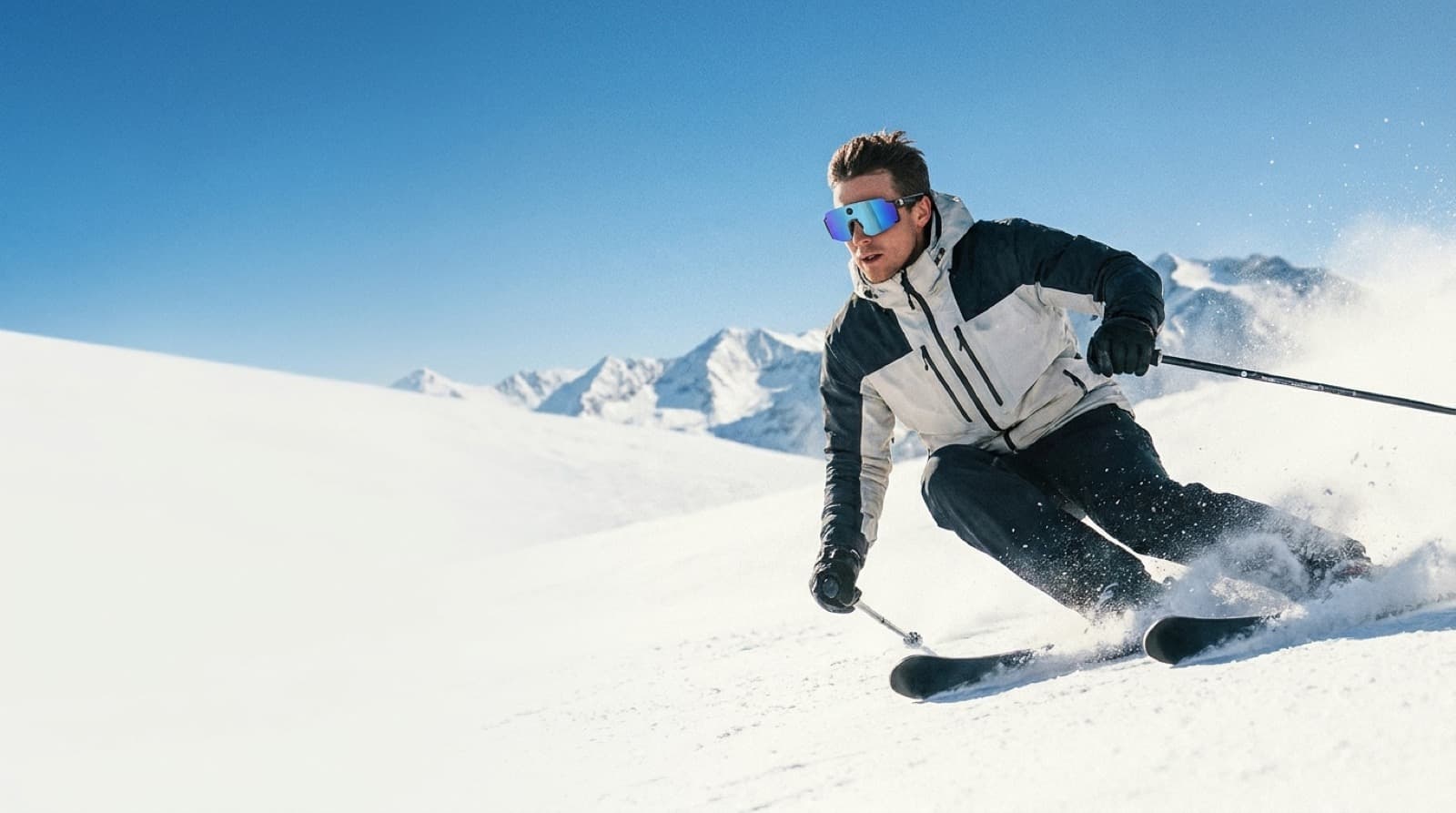
3. Light: canopy to ridgeline, all day
This is the lens argument that decides most hiking purchases, and it is genuinely different from the road or the gym. A trail hour can contain deep beech shade, a scree traverse in full sun, a col with snow reflecting from below, and then trees again. A single fixed tint is wrong for at least half of that.
Photochromic lenses react to ultraviolet light, and they are not symmetrical: darkening takes seconds, clearing takes minutes. Step out onto a ridge and they keep up. Drop back under a canopy and you are darker than you want for a little while. Knowing that in advance is the difference between the lens feeling smart and feeling slow. They are available on the M08, M02C, M08C.
The M14 is the exception and it is a hard one: its shield is fixed. One piece of PC, chosen with the colourway — Nero smoke, Azzurro blue mirror, Ghiaccio ice-blue mirror, Tramonto sunset-red mirror — and no interchangeable lenses at all. On a forested trail that is a liability. Above the treeline, on snow, or on an exposed traverse in wind, its coverage is worth more than adaptability. Choose accordingly rather than by which frame looks sportier.
4. Hands, poles, and the photos you currently don’t take
The honest measure of a hands-free camera is not what it captures, but what it captures that you otherwise wouldn’t. With a pole in each hand, taking a phone out means stowing both or letting them swing from the straps, waking the phone, shooting, and re-gripping. Most people do that at the summit and nowhere else — which is why the light three hours in never gets photographed.
A slide-touch on the temple arm is one hand off a grip for about a second. You are aiming your head, not framing a shot, which suits landscape, trail and a companion ahead of you far more than anything requiring composition. The M14 captures 8 MP stills and stabilised 1080p from a Sony IMX219; the M08 family capture 8 MP stills and video from a camera set flush in the frame corner.
5. What works with no signal — and what simply doesn’t
This is where most product pages go quiet, so here it is plainly.
| Feature | Out of coverage? | Why |
|---|---|---|
| Photo & video capture | Works | Stores to onboard memory — 4 GB on the M14 |
| Bluetooth audio playback | Works | BT 5.4 to your phone; needs the music already downloaded |
| Phone calls | Needs a signal | The glasses are a headset; the network is your phone’s |
| Live translation | Unavailable | Runs through the companion app and needs connectivity |
| AI assistant / visual AI | Unavailable | Same — the model is not on the glasses |
| Navigation, maps, SOS | Not a feature at all | No GPS, no display, no satellite radio in any frame |
Onboard memory is the spec that matters most here and the one nobody reads. It is the difference between a day’s captures existing on the glasses and a day’s captures depending on a phone staying awake and paired in a hip belt pocket. The M14 has 4 GB; it transfers later.
6. Rain, stream crossings and the rating
The M14 is IPX4 — splashing water from any direction, which covers rain, spindrift, and the sweat of a long climb. The M02C is IP65, the highest rating in the line. Neither is waterproof. A stream crossing, a pair dropped into a tarn, or a pack that ends up underwater is outside what any of them survive. On a trail the correct habit is the one you already have with a phone: when it turns properly wet, they go in a dry pocket.
7. Weight, hats and eight hours
Over a day, grams accumulate into a pressure point on the bridge of your nose. The M02C at ~41 g is the lightest camera frame we make, the M08 and M08C sit at ~42 g, and the M14 is 52 g. Under a beanie or a brimmed hat, the M08 family’s curved temple tips are the more comfortable shape; under a scrambling helmet, the M14’s straight PC temple arms slide along the head more cleanly, the same reason they suit a cycling helmet.
Requirement → capability → frame
| On trail | What it needs | Frame |
|---|---|---|
| Forest-to-ridge light all day | Photochromic lens | M08 $149 / M02C $159 / M08C — not the M14 |
| Longest audio between charges | Listening-biased battery | M08 family — 7 h listening |
| Rain, all day, year-round | Highest seal in the line | M02C — IP65 (M14 is IPX4) |
| Snow glare, wind, exposed traverse | Wrap coverage, fixed shield | M14 $199 |
| Capture with poles in both hands | Slide-touch, 8 MP | Every frame |
| Captures that survive with no phone | Onboard memory | M14 · 4 GB |
| Least weight over eight hours | Grams | M02C ~41 g · M08 ~42 g · M14 52 g |
| Hut-to-hut abroad, mixed languages | Live translation (needs phone + signal) | M08 family 40+ · M14 139 languages |
| Hear the trail, the group, the weather | Open-ear directional audio | Every frame — nothing in the canal |
| Navigation and emergency contact | Map, compass, satellite communicator | None of ours — no GPS, no SOS, no display |
Which frame
- M08 — $149. The default hiking pick. ~42 g Italian TR90, 8 MP camera at the bridge, 7 h listening / 4 h calls, and three interchangeable lenses — order photochromic, which is the single most useful option on a trail. Ships from Chicago, IL in 5–9 business days.
- M02C — $159.For wet hiking: IP65, the highest water rating we make, at ~41 g, with dual stabilisation and the “Hey Cyan” visual assistant — useful for identifying what you are looking at, when you have a signal. 5–9 business days in the US.
- M14 — $199. For alpine, snow and exposure: a 52 g wrap with a fixed one-piece PC shield in four colourways, IPX4, 8 MP Sony IMX219 with stabilised 1080p, 4 GB onboard, 139-language translation, 4 h listening / 7 h calls. No lens swapping — the trade you accept for coverage. Ships in 9–14 business days.
Bottom line
For most hiking, buy the M08 at $149 with the photochromic lens: seven hours of listening, forty-two grams, and a lens that keeps up with the light a trail actually gives you. Move to the M14 at $199 only when exposure, snow and wind matter more than lens flexibility. Plan your day knowing that nothing charges out there, that translation and the assistant stop at the edge of coverage, and that none of this belongs in your safety plan — carry a map and, where the route warrants it, a satellite communicator.
Free shipping from $99, a 2-year limited warranty against defects. Related reading: how photochromic lenses actually behave, smart glasses for travel, and smart glasses for running if your trail days are faster than they are long. Every frame side by side on the comparison page.
Cross-shopping the obvious pair first is reasonable. Our Ray-Ban Meta alternatives guide lays out where a $149 frame matches it and where it plainly does not.
Frequently asked questions
Will smart glasses last a full day of hiking?
Not on continuous audio, and no frame in this price band will. The M08, M02C and M08C run about 7 hours of listening from a ~300 mAh cell; the M14 runs 4 hours of listening and 7 of calls. A full trail day is eight to ten hours. Treat audio as something you switch on for stretches, keep capture for moments rather than continuous video, and carry a power bank if you want the glasses live at the summit as well as the trailhead.
Can you charge smart glasses on the trail?
Only from a power bank you carry, and only with the right cable. The M02C charges over a magnetic pogo connector, so the cable in its box is the one that works — a spare USB-C cable in your pack will not save you. A full charge takes about 2 hours, which in practice means charging at camp rather than at a lunch stop.
Do photochromic lenses work well for hiking?
Better here than almost anywhere else, because a trail swings between closed canopy and open ridgeline all day. Photochromic lenses react to ultraviolet light: they darken within seconds of stepping into the open and clear more slowly — minutes rather than seconds — when you go back under trees, so a fast transition can leave you darker than you want briefly. They also run darker and clear more slowly in cold, which on a winter hike is a feature at altitude and a nuisance in a forest. Available on the M08, M02C and M08C.
Does the M14 have interchangeable lenses for changing light?
No. The M14's shield is a fixed one-piece PC lens, chosen with the colourway — Nero smoke, Azzurro blue mirror, Ghiaccio ice-blue mirror or Tramonto sunset-red mirror. There is no photochromic, sun or clear swap. For hiking where light changes constantly, that is the argument for an M08-family frame instead, and it is one of the few places where the sportier-looking frame is the wrong tool.
Do smart glasses work without cell service on a trail?
Partly, and it is worth knowing exactly which parts. Photo and video capture work with no phone and no signal, storing to onboard memory — 4 GB on the M14. Bluetooth audio from music already downloaded on your phone works with no signal. Live translation and the AI assistant do not: they run through the companion app and need connectivity. Out of coverage, they are simply unavailable.
Are hiking smart glasses waterproof in rain?
They are rain-resistant, not waterproof, and the distinction matters more on a trail than in a city. The M14 is IPX4 — splashing water from any direction, so rain and sweat are fine. The M02C is IP65, the highest rating in the line. Neither is rated for submersion: a stream crossing, a dropped pair in a tarn, or a pack left underwater is outside what any of them survive. If the weather turns properly, they go in a dry pocket like anything else electronic.
Can I take photos while using trekking poles?
This is the strongest case for them on a trail. With a pole in each hand, taking a phone out means stowing or dangling both, and most people simply stop bothering — which is why the good light on the ridge never gets photographed. A slide-touch on the temple arm is one hand off a pole grip for about a second. You aim your head rather than a viewfinder, so it suits landscape and trail more than anything that needs composition.
Do OXIVUE glasses have GPS, maps or an SOS beacon?
No, and this one matters. There is no GPS receiver, no map display, no satellite messaging and no emergency SOS in any OXIVUE frame — no display in the lens at all. They do not belong anywhere in your safety plan. Carry a map, a compass you can use, and a satellite communicator if your route warrants one.
Which OXIVUE model is best for hiking?
The M08 at $149 for most hikers: about 42 g, 7 hours of listening, and interchangeable photochromic lenses that suit forest-to-ridge light better than any fixed tint. The M02C at $159 if you hike in wet weather — 41 g, IP65, and the 'Hey Cyan' visual assistant. The M14 at $199 makes sense for exposed alpine and winter days where a wrap's coverage against wind, snow glare and grit is worth more than lens flexibility.