Mountain guide · 2026
Ski camera glasses: sunglasses, not goggles.
A mountain is a hostile environment for a small battery, a touch sensor and a lens, and most pages about ski smart glasses pretend otherwise. This one starts with the four places they genuinely struggle — cold, storm days, fog and gloves — and then explains what they are actually excellent at.
Still deciding? Get the M02C, M08 and M08C comparison in your inbox, with your new-customer price already applied.
One email with the comparison, one follow-up a few days later. Unsubscribe any time.
The distinction that decides your purchase
Search results for ski smart glasses blur two very different objects together: goggles with electronics in them, and sport sunglasses with electronics in them. They are not interchangeable, and the difference is not a spec — it is a seal.
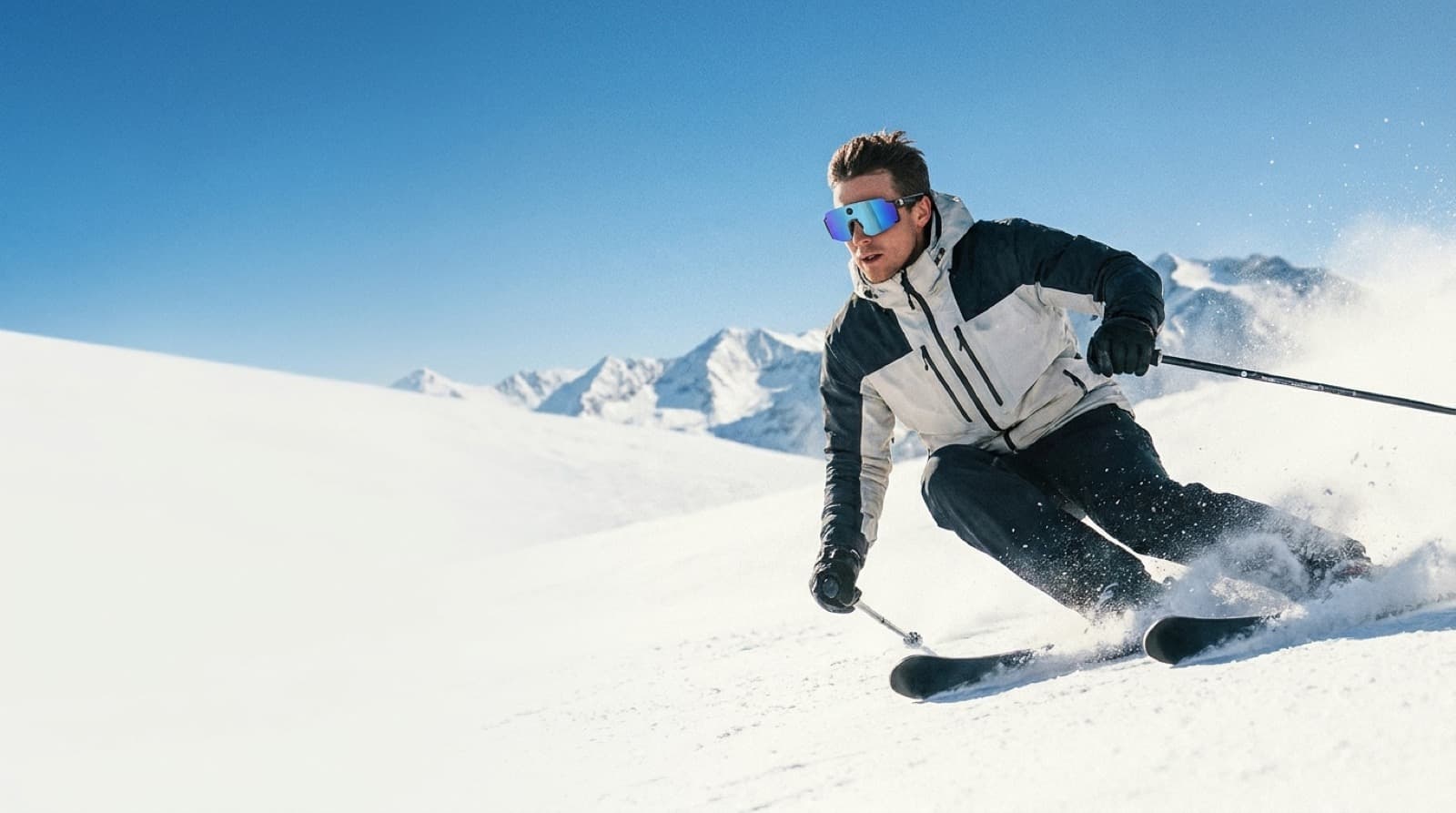
Goggles enclose your eye socket against a foam gasket. That seal is what keeps wind-driven snow out at 40 mph, what keeps your eyes from watering on a cold descent, and what makes them the only sane choice on a storm day. Sport sunglasses do not seal. The OXIVUE M14 at $199 is firmly in the second category: a one-piece polycarbonate wrap shield, 52 g, 150 × 56 × 169 mm, with an 8 MP Sony IMX219 camera and open-ear audio.
So be blunt about where each one belongs:
- Where the M14 is the right tool: spring skiing, bluebird days, warm afternoons when goggles cook your face, lift laps at a resort, groomer cruising, the walk from the lodge to the lift, the parking lot, the après terrace, and the entire non-skiing two-thirds of a ski trip.
- Where goggles win and it is not close: snowfall, wind, flat light, cold enough that your eyes water, anything at speed in weather, and night skiing in falling snow.
Most skiers who buy sport smart glasses end up carrying both and swapping at the top of the gondola. That is the honest usage pattern, and it is worth knowing before you spend $199 expecting one object to cover a whole season.
1. Cold and lithium batteries — the part nobody advertises
Every battery specification you have ever read on a wearable is a room-temperature number. Lithium-ion cells rely on ions moving through an electrolyte, and as temperature falls that movement slows and internal resistance climbs. The practical result is that a cell reports less usable capacity in the cold, and the voltage sags harder under load — a battery reading half full at 70°F can behave like a nearly-empty one at 15°F.
The M14 runs a 300 mAh cell rated at 4 hours of listening and 7 hours of calls, with about a 2-hour full charge. On a genuinely cold day, plan for noticeably less than those numbers and build a charging habit around lunch rather than expecting a dawn-to-close run on one charge. Two things worth knowing:
- The loss is temporary, not damage. Capacity returns once the pack warms up. A pair that dies on the last run will often show charge again in the car.
- Video is the heaviest draw. If you plan to capture, capture in short clips rather than leaving video rolling — the listening rating assumes audio, not a camera and an encoder working at the same time.
The same physics applies to your phone, which matters because the translation and AI features live in the companion app. A phone in an outside jacket pocket at 15°F is the first thing on the mountain to shut down.
2. Snow glare, and what our lens options actually do
Snow reflects a large share of the ultraviolet hitting it, and UV intensity rises with altitude. That is why a bright ski day is optically more punishing than a bright beach day and why lens choice matters more here than almost anywhere else.
There are two very different answers in the OXIVUE line, and they are not interchangeable:
- M14 — a fixed shield, chosen once. The one-piece polycarbonate lens comes in four colourways and cannot be swapped: Nero (smoke), Azzurro (blue mirror), Ghiaccio (ice-blue mirror) and Tramonto (sunset-red mirror). For a bright day this is the point. For flat light or dusk it is a limitation you should price in — there is no clear option.
- M08 family — three lenses, including photochromic. The M08 ($149), M02C ($159), M08C ($169) each offer photochromic, full-tint sun, or clear. Read the photochromic explainer before you assume this solves the mountain.
The honest wrinkle with photochromic on snow: those lenses darken in response to UV, and alpine UV is abundant, so they go dark fast and sit dark. Cold makes it more pronounced — photochromic lenses reach a deeper tint at low temperatures and take longer to clear again. Excellent on the hill; slightly annoying when you walk into a dim lodge and stay tinted for a while. And unlike the M14, an M08-family frame is a round lifestyle silhouette with straight temples — great for the village, not built to stay put at speed.
Polarised lenses are a genuine debate among skiers — some avoid them because polarisation can flatten the visual cue that distinguishes ice from snow. We do not list a polarised lens option on any model, so the debate does not apply to us either way. Saying so is more useful than implying a feature we do not sell.
3. Fogging — better than goggles on the move, worse when you stop
Fog forms when warm, moist air from your face meets a lens colder than the dew point. A sealed goggle fights this with a vented double lens and a fan of airflow you cannot control; a frame with open sides simply lets air through.
In practice, this means sport sunglasses fog less while you are moving and can fog when you stop — at the lift line, in a queue, or when you pull a buff up over your nose and vent your breath straight upward into the lens. We do not claim an anti-fog coating on the M14 shield, so treat the usual habits as necessary rather than optional: vent your breath downward, avoid parking them on a hot forehead, and let them equalise outside instead of taking them from a warm lodge straight onto a cold face.
4. Gloves and touch controls — a real ergonomic problem
The M14 is operated with a slide-touch surface on the temple plus wear detection. A capacitive surface behaves with a ski glove exactly the way your phone screen does: badly. With a thick glove or a mitten you should assume you have no reliable control at all.
What actually works on a ski day:
- Start a capture at the top, before you drop in — not mid-run.
- Bare one hand for a moment when you want to change something, on the lift rather than the run.
- Treat mid-run control as unavailable and plan the clip in advance.
Liner gloves help. Thin spring gloves are usable. Insulated mittens are not. This is a limitation of every touch-controlled frame on the market, not something specific to ours, but it is the kind of thing you only find out on day one.
What they are genuinely excellent at
Everything above is the case against. Here is the case for, and it is a narrow, real one: the capture you were never going to get out a phone for.
A chairlift is the single best filming position on a mountain and the worst place to handle a phone — gloves on, poles across your lap, a 40-foot drop under your boots. Eye-level capture removes the whole negotiation. The same applies to the group at the top before anyone drops, the traverse through the trees, and the two seconds after your friend finally lands the thing they have been trying all morning.
On the M14 that is 8 MP stills and 1080p 30 fps video with electronic image stabilisation, written to 4 GB of onboard memory and transferred over Wi-Fi afterwards — so your phone can stay zipped in an inside pocket where it is warm. Two honest limits: EIS is software, not a gimbal, so a chattery icy run will still look chattery; and a helmet-mounted action camera is a better tool for filming an entire top-to-bottom descent.
The other real win is the audio. Open-ear directional drivers sit outside your ear canal, so music and calls arrive without closing off the mountain — you still hear the skier overtaking you, the lift attendant, and your group. On a hill, that is a safety argument, not a comfort one.
Sport sunglasses vs. goggles vs. a helmet camera
| OXIVUE M14 ($199) | Ski goggles | Helmet action camera | |
|---|---|---|---|
| Seals against wind & snow | No — open sides | Yes, that is the point | n/a |
| Best conditions | Bluebird, spring, warm days | Storm days, cold, flat light | Any, if you set it up |
| Fogging | Less on the move, more at a stop | Vented double lens, fogs when parked on a forehead | n/a |
| Capture | 8 MP stills · 1080p 30 fps · EIS · 4 GB onboard | None | Full runs, swappable battery, mounts |
| Audio & calls | Open-ear directional · 4 h listening / 7 h calls | None | None |
| Operable in thick gloves | No — capacitive slide touch | n/a | Usually, via a physical button |
| Cold-weather runtime | Reduced — plan for a lunchtime charge | n/a | Reduced, but batteries swap |
| Wearable off the hill | Yes — sunglasses in the village | No | No |
| Water rating | IPX4 splash — never immersion | n/a | Varies |
What to actually buy
- You ski mostly spring and bluebird days, and want the clips: the M14 at $199. Pick Nero (smoke) for the brightest days; the three mirrored options are a style call more than a performance one. Ships in 9–14 business days.
- You ski in weather and want one pair for the trip, not the run: keep your goggles and buy an M08-family frame with the photochromic lens — the M02C at $159 is the one to look at, since it is the only frame in the range with an IP65 rating and it ships in 5–9 US business days.
- You want a camera on your head for full descents: buy an action camera. That is not the job these do, and buying one anyway is a change of mind we cannot refund.
More context on the wrap format and what the sport-brand premium actually buys: the wrap-shield comparison. For the whole line side by side, the comparison page. If you want a frame for the flight and the village instead of the piste, see smart glasses for travel.
Shipping and returns. Free shipping from $99. The M14 ships in 9–14 business days; the M08, M02C and M08C ship in 5–9 US business days from Chicago, IL. No refunds except transit damage (replaced or refunded); faults are repaired or replaced under the 2-year warranty; change of mind and unmet expectations are not refundable. Water damage beyond IPX4 is excluded from warranty — it falls under the paid repair program instead.
Skiers cross-shopping the mainstream option should start with the Ray-Ban Meta alternatives comparison, which is where the price-versus-ecosystem argument actually gets settled.
Frequently asked questions
Can you wear smart glasses skiing?
Yes, with one condition worth stating first: sport smart glasses are sunglasses, not goggles. The OXIVUE M14 at $199 is a 52 g one-piece wrap shield — it handles bluebird spring days, lift laps, groomer cruising and the lodge-to-lift walk. On a storm day with wind-driven snow, goggles seal your eye socket and sunglasses do not, and no camera or speaker changes that. Plenty of skiers carry both and swap at the top.
Do smart glasses lose battery in cold weather?
Yes, and any brand that says otherwise is selling you something. Lithium-ion cells lose usable capacity as they cool — the chemistry slows, internal resistance rises, and the runtime you saw in the specs is a room-temperature number. The M14's 300 mAh cell is rated 4 hours of listening and 7 hours of calls; on a genuinely cold day plan for meaningfully less and charge over lunch. The capacity comes back when the battery warms up. Nothing is damaged.
Are ski camera glasses better than a helmet action camera?
They are different tools. An action camera on a helmet mount is purpose-built for a full run: bigger sensor stabilisation, mounting options, a battery you can swap in a glove. Camera glasses win the three seconds you were never going to spend setting up — your friend's drop-in from the lift, the group at the top, the trees on the traverse. The M14 shoots 8 MP stills and 1080p 30 fps video with electronic stabilisation to 4 GB of onboard memory, so nothing needs your phone on the mountain.
Will they fog up on the slopes?
Less than goggles on the move and more than you'd like when you stop. Fog is warm moist air meeting a cold lens, and a frame with open sides has far more airflow than a sealed goggle — which is exactly why sunglasses are the better choice on a warm spring afternoon and the worse one in a blizzard. We make no anti-fog coating claim for the M14 shield. The standard habits still work: don't tuck your face into a buff that vents upward, and don't push them onto a hot forehead at the lift line.
Can I use the touch controls with ski gloves on?
Honestly, not well. The M14 uses a slide-touch surface on the temple, and a thick glove or a mitten defeats it the same way it defeats a phone screen. Practical answer: bare a hand for a moment at the top, start capture before you drop in rather than mid-run, and treat mid-run control as something you won't have. This is a real ergonomic limitation of every touch-controlled frame, not a defect.
Which OXIVUE model suits skiing?
The M14 at $199 — it is the only wrap-around shield in the line, 52 g, IPX4 splash-rated, with a curved one-piece lens that stays put at speed. The M08 family (M08 $149, M02C $159, M08C $169) are round lifestyle frames with straight temples; they are the better après-ski and travel glasses, but they will slide on a warm nose and only the M02C carries a water rating at all (IP65).
Is IPX4 enough for snow?
For falling snow, spindrift and a wet chairlift seat, yes — IPX4 covers splashing water from any direction. What it does not cover is immersion. If they go into a tree well or under wet spring slush and stay there, that is water damage rather than a warranty case; our warranty explicitly excludes water damage beyond IPX4, though the paid repair program can often still help.
Do photochromic lenses work for skiing?
They work harder than most people expect, which cuts both ways. Photochromic lenses darken in ultraviolet light, and UV at altitude is intense and doubled by reflection off snow — so they go dark quickly and stay dark. Cold also makes photochromic lenses darken more deeply and clear more slowly than they do in summer. On the M08 family that is arguably ideal on the hill and inconvenient when you step into the lodge. The M14 does not offer photochromic at all: its shield is fixed.
Can you wear them under a ski helmet?
Sunglasses and a ski helmet are a standard combination, and the M14's temples sit under the helmet edge like any sport frame. The caveat is fit: helmet liners vary enormously in how much they press on the temple, and the M14's temples carry electronics so they are thicker than a bare wire arm. If your helmet is snug, wear them together for an hour before committing to a full day. No refunds except transit damage (replaced or refunded); faults are repaired or replaced under the 2-year warranty; change of mind and unmet expectations are not refundable.
Will they stay on if I fall?
No pair of sunglasses will reliably survive a serious tumble on your face, and we are not going to claim otherwise. The wrap shape and 52 g mass help at speed and in wind; a hard fall is a different event. Do not treat any eyewear as protective equipment — the shield is a polycarbonate lens, not certified impact protection, and a helmet and proper goggles exist for that job.
Do the AI features work on the mountain?
Capture and playback work on the glasses alone. Live translation across 139 languages and any AI question-answering run through the free HeyCyan companion app on your phone, which means they need your phone within Bluetooth range and, for translation, a working data connection. On a lift with no signal, translation will not work. That matters more than it sounds if you are skiing abroad and expecting to use it on the hill rather than in the village.
How fast do they ship, and can I return them?
The M14 ships in 9–14 business days — it is not one of the three US-warehouse models (the M08, M02C and M08C ship in 5–9 business days from Chicago, IL). Free shipping from $99, a 2-year warranty against defects.