Eye protection · 2026
Safety glasses with a camera, and what the rating decides.
Safety glasses with camera combines two questions: does the eyewear protect, and does it capture? This guide covers when a job requires rated eye protection, what ANSI Z87.1 means, and which tasks suit camera glasses that carry no impact rating.
Still deciding? Get the M02C and M08 comparison in your inbox, with your new-customer price already applied.
One email with the comparison, one follow-up a few days later. Unsubscribe any time.
1. What ANSI Z87.1 means
ANSI Z87.1 is the standard OSHA names when it says protective eyewear must be adequate. In its general-industry eye and face rule, 29 CFR 1910.133 (checked November 6, 2026), OSHA says protective devices must meet one of three editions: ANSI/ISEA Z87.1-2010, ANSI Z87.1-2003 or ANSI Z87.1-1989 (R-1998). The practical meaning for a buyer: “safety” is not a feature a seller can add by naming a product. It is a claim a maker documents against that standard, and it applies to the eyewear as built, with its frame and lenses.
A camera does not move a pair of glasses in or out of that category. A rated frame with a camera attached is still judged on its rating; a non-rated frame with a camera is still non-rated. When you see “safety glasses with camera” in a listing, look for the maker’s own published rating or documentation for that exact product, and treat the phrase on its own as a search term, not evidence.
We did not fetch the standard itself or the safety-equipment association’s page for this guide, so we do not explain test methods or frame markings here. Read the maker’s documentation and ask your safety officer.
2. When rated eyewear is required
Rated eyewear is required when there is an eye or face hazard, and your employer’s hazard assessment, not your gear, decides which tasks count. OSHA 1910.133(a)(1) (checked November 6, 2026) says each affected employee must use appropriate eye or face protection when exposed to hazards from flying particles, molten metal, liquid chemicals, acids or caustic liquids, as well as chemical gases or vapors and potentially injurious light radiation.
The construction rule, 29 CFR 1926.102 (checked November 6, 2026), uses the same “appropriate eye or face protection” wording and adds that eye protection must provide side protection when there is a hazard from flying objects. OSHA’s eye and face protection page (checked November 6, 2026) states the general principle: eye and face protection must be provided whenever necessary to protect against chemical, environmental, radiological or mechanical irritants and hazards.
If a task is on your employer’s list, the answer is simple: wear rated eyewear and put the camera question aside. If you are not sure, ask before you start the task, not after. This page covers the US OSHA rules named above only; if you work elsewhere, check the rules that apply to you.
3. How to check a listing that says “safety glasses with camera”
Three checks, in order, using the maker’s own documentation rather than the product title. First, does it name the standard? A listing that says “safety” without naming one gives you nothing to verify. Second, does it name the exact model you are buying, rather than a product family or a style? A rating on a related frame does not carry over to a different one. Third, is the rating stated for the finished eyewear with the camera built in, not for a lens or a frame sold separately?
If any of the three is missing, treat the product as non-rated until the maker says otherwise. Then ask your safety officer whether that product is acceptable for your tasks; the answer is theirs to give, and you can get it in writing before you buy. We do not explain the standard’s markings here because we did not fetch it.
4. What camera glasses are, and are not
Camera glasses such as the OXIVUE M08 and M02C are consumer wearables: an 8 MP camera, microphones and open-ear speakers in a lightweight frame (about 42 g for the M08, about 41 g for the M02C). Capture starts only with a touch on the temple. They connect to your phone through the companion app.
- Not rated eye protection. No OXIVUE frame publishes an impact rating. We make no safety or impact claim for any of them.
- Not hearing protection. OXIVUE makes no hearing-protection claim.
- No display. Nothing is projected in front of your eyes.
- No prescription lenses. None of our frames take them.
The M02C is listed at IP65 (dust and water jets, not immersion); the M08 has no published water rating. Neither is an eye-protection rating.
5. A decision table
| Situation | What to wear | Camera glasses OK? |
|---|---|---|
| Task is on your employer’s eye-hazard list (grinding, cutting, chemicals, flying debris) | Rated eyewear, as your employer specifies | No, not in its place |
| Unsure whether the task is covered | Rated eyewear until your safety officer says otherwise | No |
| Site walkthrough, estimating, paperwork, outside the hazard area | Whatever the site rules allow | Yes, where cameras are permitted |
| Phone calls and notes while moving between jobs | Whatever the site rules allow | Yes |
| Driving to the site, travel, weekend projects without a hazard | Your choice | Yes |
The test behind every row is the same: is there an eye hazard right now? If yes, rated eyewear and no substitute. If no, the remaining questions are about site rules and consent, covered below. For what camera glasses help with on a job site, see our guide to smart glasses for construction workers. If your workplace restricts cameras altogether, the camera-free smart glasses guide covers that case.
6. Prescription wearers
“Do prescription glasses work as safety glasses?” OSHA 1910.133(a)(3) (checked November 6, 2026) addresses people who wear prescription lenses during eye-hazard operations: they need protection that incorporates the prescription or can be worn over their lenses without disturbing the position of either. Ordinary prescription glasses are not described there as protective eyewear.
OXIVUE frames cannot solve this: none of our frames take prescription lenses, and none publishes an impact rating. If you need a prescription and a camera, see prescription camera glasses for the options and their limits, and keep your rated eyewear for hazard tasks.
7. The two OSHA rules side by side
The general-industry and construction rules read alike, but they are separate regulations, and which one governs you depends on the kind of work, not on the glasses. Here is what each says in the text we fetched on November 6, 2026.
- 1910.133 (general industry). Paragraph (a)(1) requires appropriate protection for flying particles, molten metal, liquid chemicals, acids or caustic liquids, chemical gases or vapors, and potentially injurious light radiation. Paragraph (b)(1) names the three Z87.1 editions that protective devices must meet.
- 1926.102 (construction). Paragraph (a)(1) uses the same “appropriate eye or face protection” wording, and paragraph (a)(2) adds side protection where there is a hazard from flying objects. Paragraph (a)(3) covers prescription-lens wearers, as 1910.133(a)(3) does.
The practical point: a pair of glasses is never “compliant” in the abstract. The rule that applies to your job names the hazard, and your employer decides which tasks fall under it. We have not compared the two rules paragraph by paragraph beyond the points above, so confirm the details for your trade with your safety officer.
8. Cameras at work: consent, site rules and what the glasses do not decide
Whether you may wear a camera at all is a separate question from eye protection, and OSHA’s eye and face rules above do not answer it. The site owner, your employer or a client sets that rule, so ask for it in writing if the work involves private areas, other people’s property or sensitive information. Ask the site owner or your employer for their camera rule before you wear camera glasses on the job.
Consent is the second layer. On OXIVUE frames capture starts only with a touch on the temple. Ask before photographing anyone or sharing their image, and follow local law. Our guide to smart glasses recording laws by state is a starting point for the US, not legal advice.
A simple order of operations before you wear camera glasses on any job: first confirm the task has no eye hazard, or put on the rated eyewear that task requires; then confirm cameras are permitted where you are standing; then ask the people in frame. If any step fails, leave the camera glasses off.
9. Where OXIVUE fits
OXIVUE publishes this page, so weigh it accordingly. We sell non-rated camera glasses. Our honest position: if you are looking for eyewear that protects your eyes, we are not the answer, and no frame of ours replaces it. If you want hands-free photos, calls and notes for the parts of your day with no eye hazard, the M08 at $99 at checkout has an 8 MP camera, and the M02C at $109 adds IP65, a Sony IMX219 8 MP camera and a voice-activated visual assistant. OXIVUE does not publish which AI model powers it. The assistant is an M02C feature only.
What neither frame offers matters as much as what it does: no impact rating, no display, no prescription lenses, no hearing protection. If one of those is a requirement, look elsewhere and start from the maker’s documentation, as described in the checklist above. For a wider look at camera glasses that connect to a phone, see camera glasses that connect to phone.
Compare all frames on the comparison page, or see the M08 and M02C pages.
Shipping, refunds and warranty. Free shipping from $99. US orders typically arrive in 5–9 business days. International orders take 9–14 business days after shipment. Import VAT or duties outside the US are paid by the recipient. No refunds except transit damage (replaced or refunded); faults are repaired or replaced under the 2-year warranty; change of mind and unmet expectations are not refundable. None of our frames take prescription lenses. Read the refund policy and shipping policy.
Frequently asked questions
Are there safety glasses with a camera?
Yes, some products are sold under that name, but the name proves nothing about protection. Look for the maker's own published Z87.1 documentation for that exact model before relying on it. OXIVUE does not sell one: no OXIVUE frame publishes an impact rating, so none replaces rated eye protection. The M08 at $99 and M02C at $109 at checkout are camera-and-audio glasses for tasks with no eye hazard. Prices checked 2026-11-06; checkout price may change.
Do prescription glasses work as safety glasses?
No, not by default. OSHA 29 CFR 1910.133 (checked November 6, 2026) says workers who wear prescription lenses during eye-hazard operations need protection that either builds the prescription into its design or can be worn over the prescription lenses without disturbing their position. Ordinary prescription frames are not described there as protection. Whether a particular pair is rated is a question for its maker's documentation. OXIVUE frames take no prescription lenses.
Can I wear OXIVUE glasses instead of required safety glasses?
No. If your employer or task requires eye protection, wear eyewear that meets the standard OSHA names. No OXIVUE frame publishes an impact rating.
Is ANSI Z87.1 the standard OSHA requires?
Yes, for general industry. OSHA's rule 1910.133 (checked November 6, 2026) says protective devices must meet ANSI/ISEA Z87.1-2010, ANSI Z87.1-2003 or ANSI Z87.1-1989 (R-1998). Details of test methods and frame markings are in the standard itself, which we did not fetch for this page, so read the maker's documentation and your safety officer's guidance for what a given marking covers.
Do I need rated safety glasses for every task?
No, only for tasks with an eye or face hazard. OSHA 1910.133 (checked November 6, 2026) lists flying particles, molten metal, liquid chemicals, acids or caustic liquids, chemical gases or vapors, and potentially injurious light radiation. The construction rule, 1926.102, also asks for side protection where there is a hazard from flying objects. Your employer's hazard assessment decides which tasks are covered, not the glasses you own.
Can camera glasses take pictures without a phone in my hand?
Yes. On the OXIVUE M08 and M02C, a touch on the temple captures a photo with the 8 MP camera, and you can leave the phone in your pocket. Photos reach your phone through the companion app. There is no display, so you frame a shot by looking where you want to shoot. Ask before photographing people, and follow workplace and local rules.
Does the M02C's IP65 rating mean it protects my eyes?
No. The M02C is listed at IP65 (dust and water jets, not immersion) and publishes no impact rating; the M08 has no published water rating. Neither is a substitute for safety eyewear on any task your employer lists as an eye hazard.
OXIVUE frames side by side
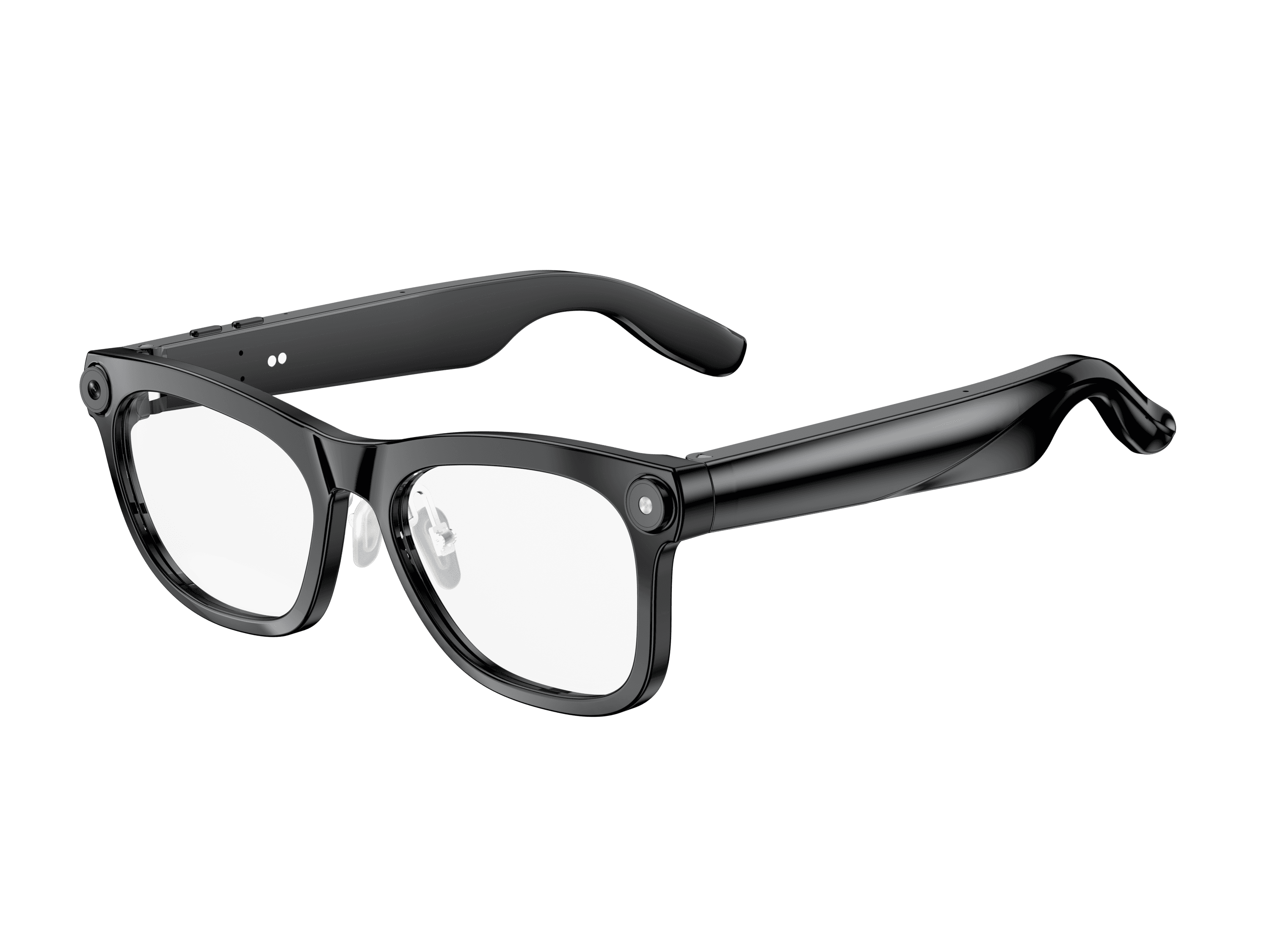 OXIVUE M02C$109 at checkout | 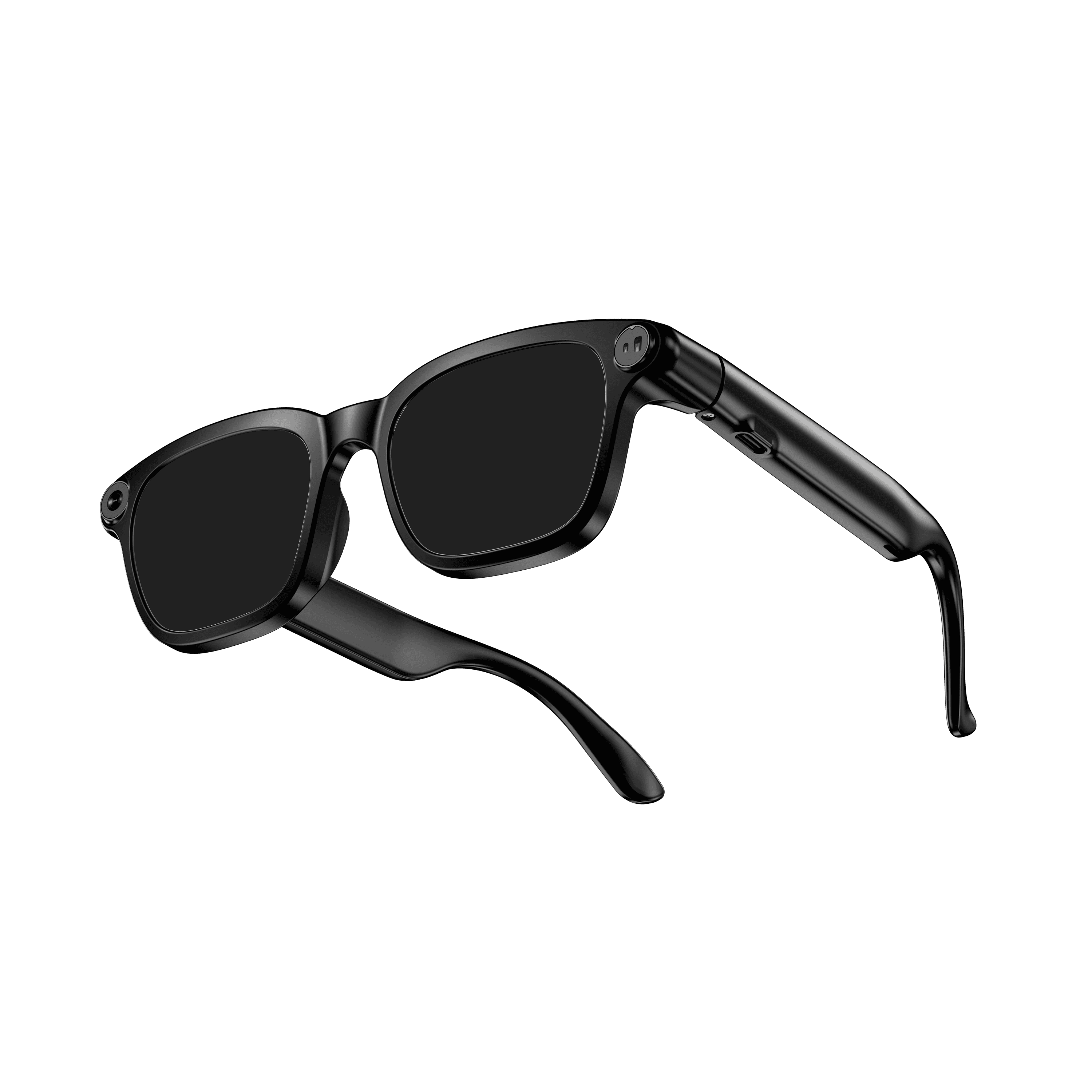 OXIVUE M08$99 at checkout | |
|---|---|---|
| Camera | 8 MP | 8 MP |
| Weight | ~41 g | ~42 g |
| Water rating | IP65 | — |
| Lenses | Sunglasses · Photochromic · Clear | Sunglasses · Photochromic · Clear |
| Translation | 40+ languages | 40+ languages |
| Visual AI | Yes | — |
From each frame’s product page. Every model: open-ear audio, Bluetooth 5.4, no subscription. Full spec table
What these frames won’t do
- No prescription lenses yet, on any model. If you need vision correction all day, these can't replace your glasses.
- No display. Nothing appears in your view; you hear answers and capture photos and video.
- Open-ear speakers leak some sound at high volume and won't block out a loud train or a windy road the way sealed earbuds do.
- Translation, music, calls and the assistant need your phone nearby and connected. Translation pauses after each sentence, and only you hear the translated audio; the other person reads the reply on your phone.
- M02C: IP65 resists dust and water jets, not immersion. No swimming, no saltwater.
- M08: no published water rating, so keep it out of heavy rain and spray.
Check these before you order: see the warranty and refund policy.