Smart glasses design · 2026
What do smart glasses look like? A tour of the parts, with photos.
If you have never held a pair, the honest answer is: like glasses, with a few tells. This page walks around a frame from the front to the tips of the temples and shows where the camera, the speakers, the microphones, the battery and the charging connection actually sit, then puts the silhouettes side by side with their real weights.
Still deciding? Get the M08, M08C and M14 comparison in your inbox, with your new-customer price already applied.
One email with the comparison, one follow-up a few days later. Unsubscribe any time.
1. The parts every pair of smart glasses has to hide
Strip the marketing away and a pair of camera-and-audio smart glasses is an ordinary frame that has found room for six things: a camera, two open-ear speakers, a set of microphones, a Bluetooth radio, a battery and a charging connection. Where a designer puts those parts decides what the glasses look like, and almost every pair on the market answers the question the same way. The camera goes at the front, because it has to see. Everything else goes in the temples, because that is the only place on a frame with enough length and depth to hide a battery and a speaker.
That is why smart glasses design has converged on familiar silhouettes. A wayfarer-style rectangle with a thick upper rim conceals a camera module well; a one-piece sport shield puts the camera in the middle and tucks the electronics into the arms. This page walks around the OXIVUE frames and points at each part, because they are the frames we can photograph and weigh ourselves. Where we mention another maker, the fact comes from that maker’s own page and is dated.
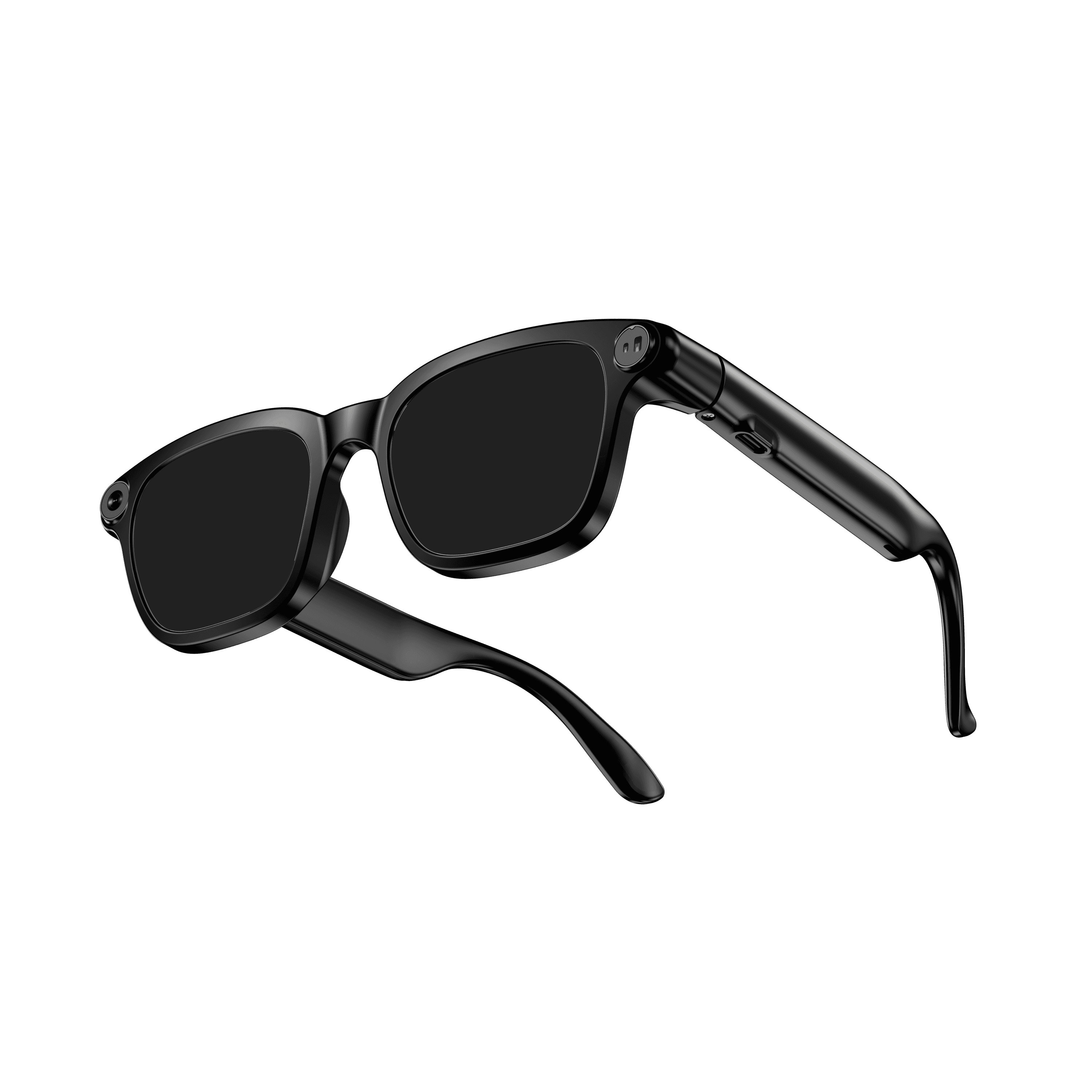
2. The front: lens and camera
The front of a pair of smart glasses is the part people look at, so it is the part designers keep closest to ordinary eyewear. On a two-lens frame like the M08, M02C or M08C the lenses are normal lenses: a full-tint sunglass lens, a photochromic lens that darkens in UV light, or a clear lens. They are not prescription lenses, and nothing is built into them: no screen, no projector. Our photochromic smart glasses guide explains how the adaptive lens behaves indoors and in the car.
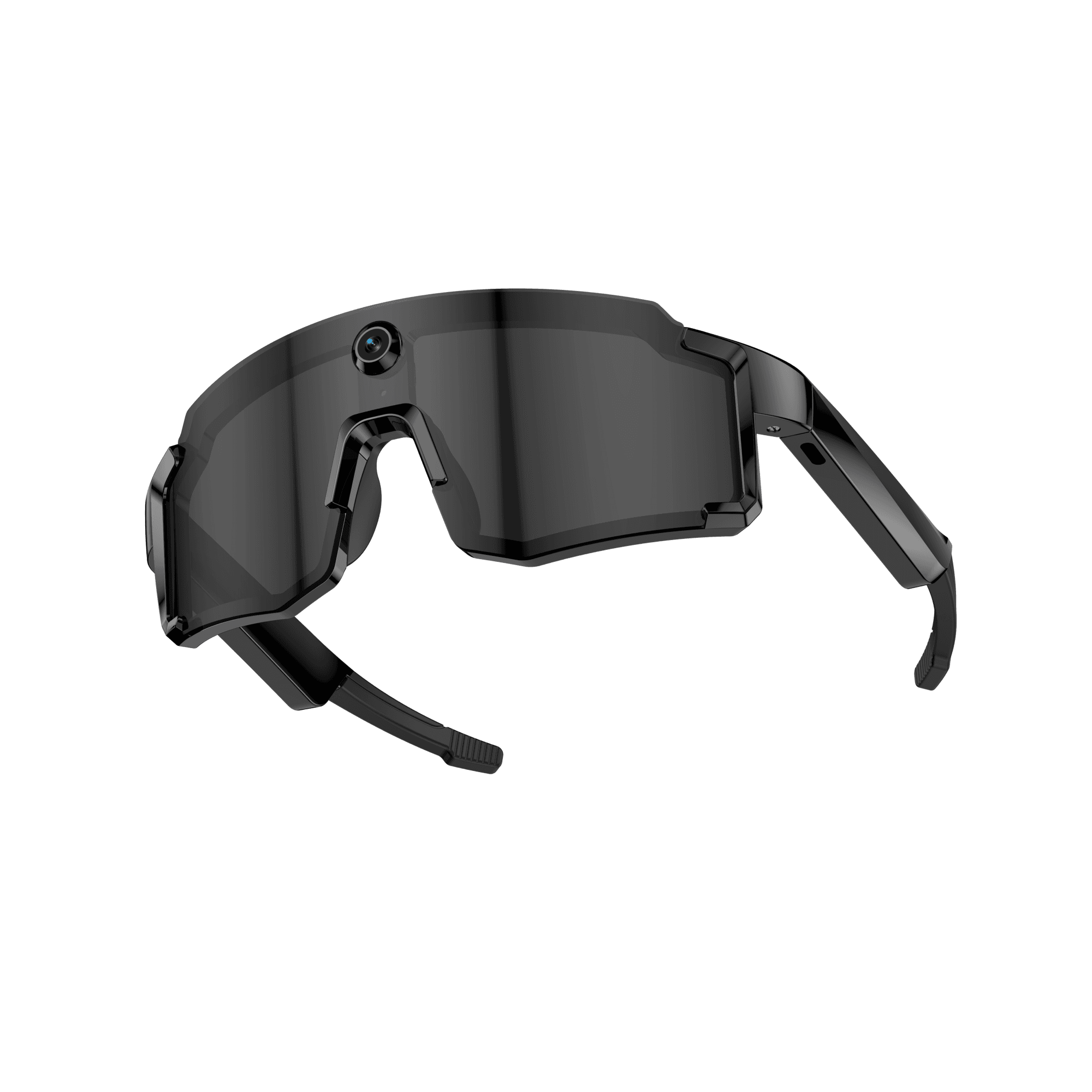
The one thing on the front that is not ordinary is the camera. It is a small round lens opening, a few millimetres across, and on the OXIVUE two-lens frames it sits flush in one front corner of the frame right beside the hinge. Look at the M08 photo above and you can see it on the left corner. On the M14 sport shield the camera moves to the top centre of the shield, above the bridge, so that it points straight down the road on a bike. In both positions it is visible from the outside. No design we know of makes the lens disappear, and we do not think one should: a camera you wear on your face ought to be visible to the people in front of it.
Behind that opening on the OXIVUE frames is an 8 MP sensor; the M02C, M08C and M14 use a Sony IMX219, and the M02C adds dual stabilisation. None of that shows from outside. What you will see, if you are close, is the lens itself.
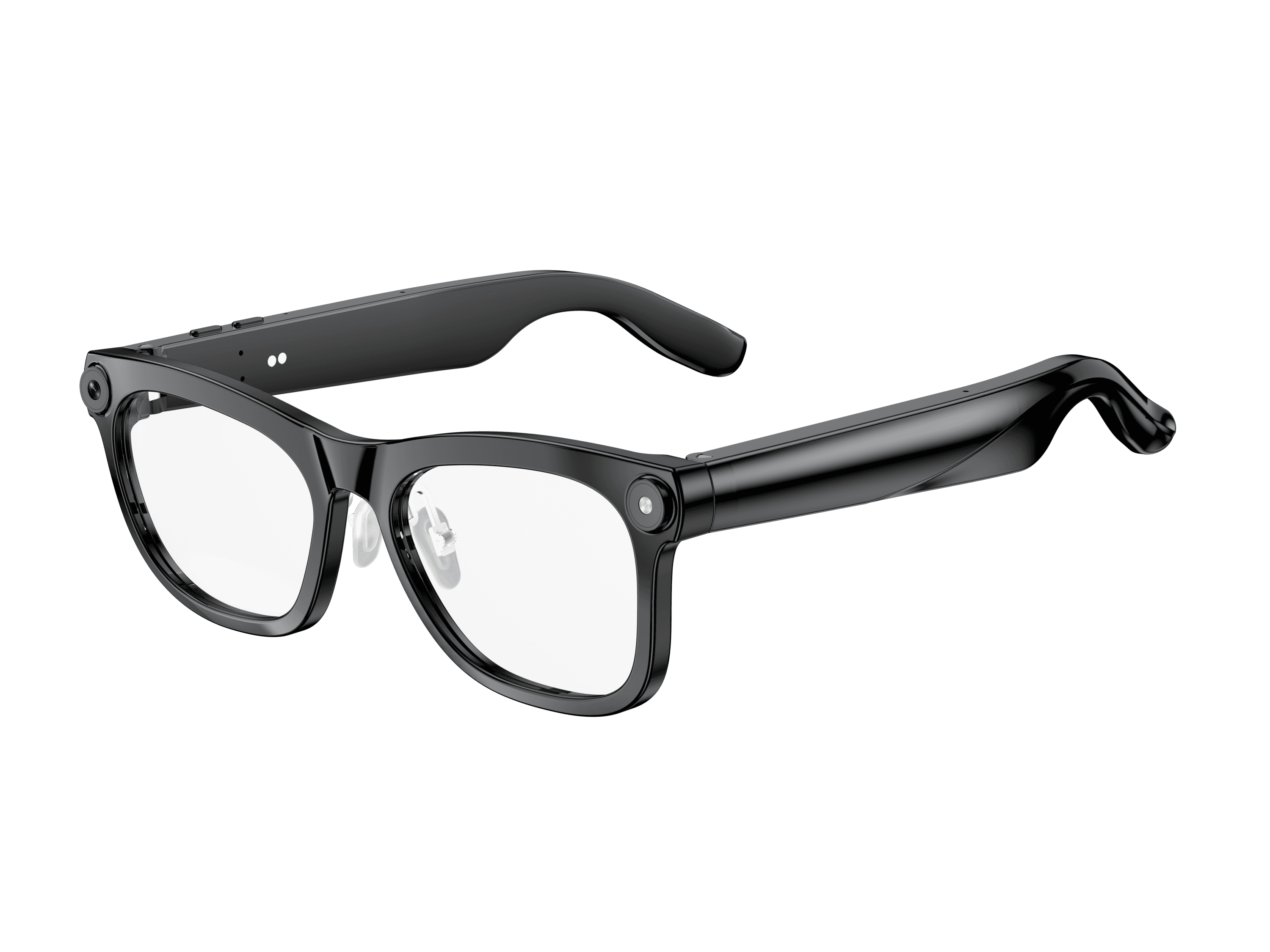
3. The temples: speakers, microphones, battery, charging and controls
Turn the frame sideways and the temples, the arms that run back over your ears, are where smart glasses stop looking like plain glasses. They are deeper from the hinge to a point above the ear, then taper to a normal tip. That extra volume is where almost everything lives.
- Speakers. Each temple carries an open-ear directional speaker that sits just above and in front of your ear, firing down toward the ear canal. From outside you see, at most, a slim slot or grille on the inside face of the arm. Nothing goes in your ear, which is why you still hear the room, and also why open-ear audio leaks a little at high volume and cannot drown out a loud street.
- Microphones. The mics show up as pinholes, usually on the temple near the hinge or on the underside of the front. They pick up your voice for calls, for the assistant and for translation, which runs through the free HeyCyan app on your phone. The M14 pairs dual microphones with a bone-conduction mic for calls in wind.
- Battery. The cell is split between the arms and is invisible. On the M08 family it is about 300 mAh (the M02C about 290 mAh), rated for 7 hours of listening or 4 hours of calls. The M14 carries 300 mAh and flips the ratio: 4 hours of listening, 7 hours of calls.
- Charging connection. Smart glasses do not take a cable in the middle of the frame; the charging connection is on one temple arm. On the M02C it is a magnetic pogo connector that snaps into place. You will see it as a small set of contacts or a port on the arm, near the hinge or at the tip depending on the model.
- Controls. There is no button cluster to spot. Capture starts with a deliberate touch on the temple, and the M14 adds a slide-touch control on the arm. The glasses do not record on their own, and they do not record because you put them on.
- Bluetooth radio. Bluetooth 5.4 on every OXIVUE frame, buried in the arm with the battery. It links the glasses to your phone; there is no SIM in any of them.
Put together, this is why a pair of AI glasses that look like normal glasses still has a recognisable profile from the side. The front can be as classic as you like; the arms will always carry a little more than an acetate frame does.
4. Three silhouettes, four frames, real weights
Across the category you meet the same handful of shapes again and again, because each one solves the packaging problem a different way. Here are the four frames we make, grouped by silhouette, with the weights from our own product data rather than a guess.
| Silhouette | OXIVUE frame | Weight | Lens | Camera position | At checkout |
|---|---|---|---|---|---|
| Wayfarer-style rectangle | M08 | ~42 g | Sun · photochromic · clear | Front corner, by the hinge | $99 |
| Wayfarer-style rectangle | M02C | ~41 g | Sun · photochromic · clear | Front corner, by the hinge | $109 |
| Same front, metal trim on the lower rim | M08C, gold or silver trim | ~42 g | Sun · photochromic · clear | Front corner, by the hinge | $119 |
| One-piece sport shield | M14 | 52 g | Fixed shield · Nero, Azzurro, Ghiaccio, Tramonto | Top centre, above the bridge | $149 |
Prices checked 2026-10-07; checkout price may change. Listed prices are $149, $159, $169 and $199; a single pair settles at the checkout price above, and two or more pairs in one order are 50% off all eyewear.
Wayfarer-style rectangle.The default shape for smart glasses, on our frames and on most others, because a deep upper rim and squared corners give the camera module somewhere to go without a bulge. The M08 and M02C share it. The M08 is a black TR90 frame with Italian construction that, in the full-tint lens, reads as a plain pair of sunglasses. The M02C, in the clear lens, comes closest to everyday optical eyewear; it is the lightest camera frame we make at about 41 g, is rated IP65 against dust and water jets (not immersion), and carries the “Hey Cyan” visual AI that can describe what you are looking at.
The same front with metal trim. The M08C keeps the black upper rim and corner camera and adds a thin metal trim along the lower rim of each lens, in gold or silver. It is the most dressed-up frame we make, which is why we point office and golf buyers at it, and it weighs about 42 g.
One-piece sport shield. The M14 is deliberately not ordinary. A single curved polycarbonate shield spans the face, the camera sits at the top centre, and the arms end in grippy tips so the frame stays put at speed. It is heavier at 52 g, rated IPX4 for splash and rain, translates 139 languages through the app, and its shield cannot be swapped for a clear or photochromic lens. Pick a colourway instead: Nero, Azzurro, Ghiaccio or Tramonto.
5. What Meta’s glasses look like, in Meta’s words
Because the frames most people have seen in public are Meta’s, it is worth saying what Meta itself says they look like. Its explainer page, checked October 7, 2026, puts it this way: “At a glance, these glasses look like normal sunglasses or prescription glasses,” and inside “they include tiny speakers, microphones, a lightweight camera or even a small display.” The same page names three Ray-Ban Meta styles, Wayfarer, Skyler and Headliner, and says that on its glasses “a tiny LED lights up to indicate to others that the camera is on.”
On price, Meta listed AI glasses starting at $224 on its site on October 7, 2026, with Ray-Ban Meta Gen 3 starting at $449, Oakley Meta HSTN starting at $399 and the Oakley Meta Vanguard sport frame starting at $499. We do not quote Meta weights or dimensions here because those pages did not show them. For a feature-by-feature comparison, see Ray-Ban Meta alternatives and Oakley Meta Vanguard alternatives.
One honest difference to note from that explainer: Meta documents a capture LED. We do not document a recording-indicator light on any OXIVUE frame, so this page does not claim one. Capture on our frames starts with a deliberate touch rather than running on its own, but whatever the hardware does, telling the people around you is your job.
6. How to tell if someone is wearing smart glasses
A checklist you can run in a second or two, from the outside in.
- Check the front corners and the bridge. A small round lens opening in one corner by the hinge, or at the centre of a shield, is a camera. Plain glasses have nothing there.
- Look at the arms from the side. Smart glasses have temples that are visibly deeper from the hinge to above the ear, then taper. Plain acetate arms are a thin, even strip.
- Look for pinholes and slots. Microphone openings near the hinge and a speaker slot on the inside of the arm are small, but they are there.
- Watch for a light. Some makers, Meta among them, fit an LED that shows when the camera is on. Not every pair has one, and ours is not documented to, so treat a light as a yes and the absence of one as no information.
- Notice a touch. On frames like ours, a photo or clip begins with a deliberate touch on the temple. A hand to the arm of the glasses is the tell.
It cuts the other way too. If you are the one wearing them, the courteous thing is to say so before you record anyone, and in some places the law requires consent for audio. Our recording laws by state guide sets out the US rules; it is general information, not legal advice.
7. What you see (and hear) when you wear them
From the inside, camera-and-audio smart glasses look like nothing at all, which surprises people who expect a heads-up display. You see the world through a sunglass, photochromic or clear lens, the same as any other pair. No icon floats in the corner, no text scrolls past, no map appears. Glasses that do put an image in your eye are a separate category with its own trade-offs in weight, battery and price; the smart glasses with display guide covers them, and AI glasses vs smart glasses sorts out the names.
What changes is sound. Music, calls and navigation prompts arrive from just above your ears while the room stays audible. Ask the assistant a question and the answer comes the same way. Use translation and the translated speech is heard only by you through the open-ear speakers; the other person reads the reply on your phone, and the app pauses after each sentence. Photos and clips go to the phone app, because there is no screen on the glasses to look at them on.
A 41 or 42 g two-lens frame sits on the nose like a slightly substantial pair of sunglasses; the 52 g M14 shield feels like sports eyewear with a bit more in the arms. If you want the shapes compared on looks alone, read stylish smart glasses; if you want the plainest possible pair, smart glasses that look like normal glasses is the deeper dive. Every current model, side by side, is on the comparison page.
Shipping, refunds and warranty. Free shipping from $99 to 39 countries. US orders typically arrive in 5–9 business days; international orders take 9–14 business days after shipment, with import VAT or duties paid by the recipient. No refunds except transit damage (replaced or refunded); faults are repaired or replaced under the 2-year warranty; change of mind and unmet expectations are not refundable. None of our frames take prescription lenses. Details on the shipping policy and refund policy pages.
Frequently asked questions
How can I tell if someone is wearing smart glasses?
Look at the front corners and the temples. Camera glasses have a small round lens opening at the front, usually in one corner by the hinge or at the bridge, and their arms are deeper than a plain acetate pair because the speakers, microphones and battery live there. From across a room most pairs pass as ordinary eyewear; at arm’s length the lens and the thicker arms are visible. Some makers add an indicator light; Meta’s own explainer page says a tiny LED lights up on its glasses when the camera is on (checked October 7, 2026). We do not document a recording-indicator light on any OXIVUE frame, so this page does not claim one.
What do you see wearing smart glasses?
On camera-and-audio glasses like OXIVUE’s, you see exactly what you would see through ordinary sunglasses or clear lenses: nothing is projected into your view, because there is no display. What changes is what you hear. Open-ear speakers in the temples play music, calls, navigation prompts and translated speech without covering your ears. Glasses with a display are a separate category; our smart glasses with display guide covers those.
What are the downsides of wearing smart glasses?
The arms are thicker than plain frames, the pair weighs a little more (about 41 to 42 g for the OXIVUE two-lens frames, 52 g for the M14 shield), and you charge them like any other gadget. Open-ear speakers leak some sound at high volume and cannot block out a loud street. Translation, the assistant and file transfer need your phone nearby. None of the OXIVUE frames takes prescription lenses, so if you need vision correction all day they cannot replace your regular glasses.
Are there any smart glasses that look normal?
Yes. Screenless camera-and-audio glasses now come in ordinary two-lens silhouettes with slightly deeper temples. In a clear lens the OXIVUE M02C, at about 41 g and $109 at checkout, reads as everyday optical eyewear at conversational distance, and the M08 at about 42 g and $99 shares the same wayfarer-style rectangular silhouette. What still shows on close inspection is the camera lens in the front corner and the width of the arms, which we think is the right outcome for a product with a camera in it.
Where is the camera on smart glasses?
There are two common placements. On the OXIVUE M08, M02C and M08C the 8 MP camera sits flush in one front corner of the frame, next to the hinge. On the M14 sport shield it sits at the top centre of the shield above the bridge, so it looks straight down the road. Either way the lens is a small round opening you can see from outside; no design we know of makes it disappear. Capture starts with a deliberate touch on the frame, not on its own.
Do all smart glasses have a camera?
No. The category splits three ways: audio-only glasses with speakers and microphones but no lens at the front, camera-and-audio glasses like the four OXIVUE frames on this page, and display glasses that add a screen or projection inside the lens. If the front of a frame has no round lens opening at all, it is probably an audio-only pair. Our AI glasses vs smart glasses guide explains the categories in more detail.
How much do smart glasses cost, and how do OXIVUE orders ship?
Meta lists its AI glasses starting at $224 on meta.com, with Ray-Ban Meta Gen 3 from $449 and Oakley Meta from $399 (checked October 7, 2026). OXIVUE eyewear is $99 (M08), $109 (M02C), $119 (M08C) and $149 (M14) at checkout for one pair, and two or more pairs in one order are 50% off. Shipping is free from $99 to 39 countries; US orders typically arrive in 5–9 business days and international orders in 9–14 business days after shipment, with any import VAT or duties paid by the recipient. OXIVUE does not offer refunds except for transit damage; faults are repaired or replaced under the 2-year warranty.
What these frames won’t do
- No prescription lenses yet, on any model. If you need vision correction all day, these can't replace your glasses.
- No display. Nothing appears in your view; you hear answers and capture photos and video.
- Open-ear speakers leak some sound at high volume and won't block out a loud train or a windy road the way sealed earbuds do.
- Translation, music, calls and the assistant need your phone nearby and connected. Translation pauses after each sentence, and only you hear the translated audio; the other person reads the reply on your phone.
- M08: no published water rating, so keep it out of heavy rain and spray.
- M08C: no published water rating, so keep it out of heavy rain and spray.
- M14: one-piece shield, so the lens can't be swapped for clear or photochromic.
- M14: IPX4 covers splash, spray and rain only, and at 52 g it is heavier than the 41–42 g frames.
Check these before you order: see the warranty and refund policy.