Fit · Wide faces · 2026
Smart glasses for wide faces and big heads: the sizes makers publish
Google's results for this search on October 31, 2026 were roundups, a maker's blog, forum threads, videos and a retailer listing. This guide collects the Large fits and frame widths that Meta and Dymesty publish on their own pages, explains which number to compare against your current glasses, and says plainly what OXIVUE does and does not publish.
Still deciding? Get the M02C, M08 and M08C comparison in your inbox, with your new-customer price already applied.
One email with the comparison, one follow-up a few days later. Unsubscribe any time.
1. What a wide face means in frame numbers
A wide face or a big head comes down to how wide the front of the frame is. Dymesty, a smart glasses maker, says in its fit guide (updated October 20, 2026; checked October 31, 2026) that the frame front should be “approximately the width of the wearer’s head”, citing the Vision Council. It adds: “Wide-face fit should be solved with front width before hinge flexibility.” That is one maker’s view, and it is the lens we use for the rest of this guide.
The number to compare is the width across the front, hinge to hinge. The same guide tells you to measure your current frame “hinge to hinge across the front”, to use the maker’s published front or hinge-to-hinge width when there is one, and not to treat twice the lens width plus the bridge as the total frame width. Three smaller details sit behind it:
- Lens width, bridge, temple. Many glasses list these as three numbers such as 50-22-150: lens width, bridge width and temple (arm) length, in millimetres.
- Fit options. Some makers sell one style in more than one size, or with a different nose-pad fit. Meta lists Standard, Large and High bridge options on some of its styles.
- Weight.Dymesty’s article ties discomfort to uneven weight distribution, so the weight each maker publishes is worth a look (section 4).
2. Meta: which styles come in Large
Meta’s product pages list fit options, so they are a useful place to start. On October 31, 2026, the meta.com pages we read (one colourway per style) listed Standard, Large and High bridge options for the Ray-Ban Meta Wayfarer (Gen 2 and Gen 3) and the Meta Adventurer. The Ray-Ban Meta Gen 3 Aviator and Oakley Meta HSTN pages listed Standard and High bridge options and no Large.
| Style | Fit options listed (Oct 31, 2026) | Measurements and weight (read Sept 30, 2026) |
|---|---|---|
| Ray-Ban Meta Wayfarer (Gen 2) | Standard, Large, High bridge | Standard 50-22-150, 131 mm hinge to hinge, 51 g · Large 53-22-155, 137 mm, 53 g |
| Ray-Ban Meta Wayfarer (Gen 3) | Standard, Large, High bridge | Standard 50-22-149, 129 mm, 51.5 g · Large 53-22-154, 135 mm, 53.8 g |
| Meta Adventurer | Standard, Large, High bridge | Standard 49-22-150, 53.8 g · Large 52-22-155, 54.8 g |
| Ray-Ban Meta Gen 3 Aviator | Standard, High bridge | 54-18-152, 134 mm, 54.5 g |
| Oakley Meta HSTN | Standard, High bridge | 49-23-145, 53 g |
How current is this? The fit options in the middle column were read on October 31, 2026. The measurements and weights in the last column were read from the same meta.com pages on September 30, 2026, because the measurement rows did not appear in the page text we could retrieve on October 31. The pages also link to a “Size guide” and a “Fit guide”, whose contents were not in that text either. Check the spec rows for your colour on the page before you order.
Read across the Wayfarer rows and the size step is small but real. On Gen 2, Large adds 3 mm of lens width, 6 mm of hinge-to-hinge width and 5 mm of temple length over Standard; Gen 3 adds the same 3 mm and 6 mm, with 5 mm of temple. Meta’s page text (checked October 31, 2026) does not describe which head widths each size suits. Our guide to men’s smart glasses and sizes goes through more of Meta’s styles, and the Ray-Ban Meta Wayfarer guide covers that frame on its own.
3. Another maker’s numbers: Dymesty
Dymesty publishes frame fronts in its guide (updated October 20, 2026; checked October 31, 2026): the Cook Edge as 54-19-152 with a 150 mm front, and the Jobs Circle as 50-21-152 with a 145.8 mm front. It describes each model as having a fixed dimensional size. Meta lists hinge to hinge where Dymesty lists a front, so we have not ranked the two against each other; compare like with like once you have measured your own pair the same way.
A second Dymesty article (updated October 20, 2026) gives rule-of-thumb figures for larger heads: a frame width of 145 mm or wider, temples of 145–155 mm and a bridge of 18–22 mm or adjustable. These are one maker’s guidelines on its own website. We have not tested any Dymesty frame, and none of this is independent evidence.
The forum side of the search results is anecdote. The r/SmartGlasses thread “Smart glasses for big heads? anyone tested” shows, in Google’s snippet on October 31, 2026, text naming Dymesty, Meta, Rokid and Solos as fitting bigger heads better. We could not open the thread, so treat that as one person’s experience, not a measurement.
4. Weight, hinges and the temple squeeze
Dymesty’s comfort article (updated October 20, 2026) says most discomfort comes from uneven weight distribution and rigid frames. For a head that is a bit wider than a one-size-fits-most frame, it describes the arms pushing outward while the frame presses inward. It says anything under 50 g is usually more comfortable for long wear and that its own smart glasses weigh around 35 grams. That is a vendor’s threshold and we have not tested it. For reference, the Meta weights in the table run from 51 g to 54.8 g and OXIVUE’s from about 41 g to 52 g; we draw no comfort conclusion from either range.
On hinges, Dymesty’s fit guide says a spring hinge can reduce side pressure and add tolerance, but that it “cannot make a substantially undersized frame front equal to a correctly sized one.” In Dymesty’s terms, get the width right before relying on hinges. The comfort article also suggests wearing a pair for at least ten minutes before buying and says opticians can normally adjust acetate frames with a frame heater, while some metal or rigid plastic frames are hard to change, especially around the electronics. We make no adjustability claim for any OXIVUE frame.
5. A fit checklist before you order any pair
- Measure a pair you already wear. Use a ruler across the front, hinge to hinge, and note the three numbers printed on the temple if it has them.
- Find the maker’s published width. Hinge to hinge or front, for the exact model and size. If the page does not give one, treat the fit as unknown.
- Compare the temples and the bridge. A longer temple or a Large size is not a guarantee of comfort on its own.
- Check the weight.Compare grams on the maker’s page, not words such as light or featherweight.
- Read the seller’s fit policy before ordering.Policies differ, and a style that does not suit your face may or may not be returnable. OXIVUE’s is below.
6. Where OXIVUE stands, and what we cannot tell you
OXIVUE publishes a weight for every frame it sells: the M08 is about 42 g, the M02C about 41 g, the M08C about 42 g and the M14 52 g. The M14 also lists an overall size of 150 × 56 × 169 mm (width × height × length) and a fixed one-piece shield. That is an overall dimension, a different measure from the hinge-to-hinge figures above, and we have not matched the two.
OXIVUE does not publish a figure labelled hinge to hinge or front width for any frame, so you cannot make the main comparison in this guide from our pages. For the M08 family, the product specification tables list weight, and the fit guide page on this site gives a lens-bridge-temple sizing that this page does not repeat or check. Our support page is the place to ask whether a front width is available. Weight alone is covered in the lightweight smart glasses guide.
The M08 is $99 at checkout for one pair, with an 8 MP camera and open-ear audio. It has no display, takes no prescription lenses and does not run Meta AI. A pair that does not suit your face is not refundable, so do the measuring in section 5 before you order, and see the comparison page for the other frames.
Shipping, refunds and warranty. Free shipping from $99. US orders typically arrive in 5–9 business days. International orders take 9–14 business days after shipment, and import VAT or duties outside the US are paid by the recipient. No refunds except transit damage (replaced or refunded); faults are repaired or replaced under the 2-year warranty; change of mind and unmet expectations are not refundable. None of our frames take prescription lenses. Read the refund policy and the shipping policy.
Frequently asked questions
Which smart glasses fit wide faces and big heads?
Styles that list a Large size and publish a width are the place to start. On October 31, 2026, meta.com listed a Large fit for the Ray-Ban Meta Wayfarer (Gen 2 and Gen 3) and the Meta Adventurer, and Dymesty states a 150 mm front for its Cook Edge and 145.8 mm for its Jobs Circle (guide updated October 20, 2026). Compare those with your own glasses measured hinge to hinge, and treat any brand's "fits big heads" line as a claim to check.
Is there a Large Ray-Ban Meta for a wide face?
Yes, Meta lists a Large size for the Wayfarer. On October 31, 2026, the meta.com pages we read listed Standard, Large and High bridge options for the Ray-Ban Meta Wayfarer Gen 2 and Gen 3. Read from the same pages on September 30, 2026, the Gen 2 Large is a 53 mm lens with a 22 mm bridge, 155 mm temples and 137 mm hinge to hinge (53 g), against 50-22-150 and 131 mm in Standard. The Gen 3 Aviator and Oakley Meta HSTN pages we read list Standard and High bridge options, with no Large.
Are Ray-Ban Meta glasses too small for a big head?
Not necessarily. The Large Wayfarer is 6 mm wider hinge to hinge than the Standard (137 against 131 mm on Gen 2, read September 30, 2026), with temples 5 mm longer. But Meta's page text (checked October 31, 2026) does not describe which head widths each size suits, so the answer depends on your head. Measure a pair you already wear hinge to hinge and compare it with Meta's figure for the size you are considering.
What frame width should I look for with a wide face?
Dymesty suggests 145 mm or wider for larger heads, with 145-155 mm temples and an 18-22 mm bridge (its article, updated October 20, 2026; checked October 31, 2026). Its fit guide says the frame front should be approximately the width of your head, measured hinge to hinge across the front. These are one maker's guidelines, not a standard, so check the width the maker publishes for the exact model.
Why do smart glasses hurt my temples?
According to one maker, mostly uneven weight and rigid frames. Dymesty's comfort article (updated October 20, 2026) says most discomfort comes from uneven weight distribution and rigid frames, and, for a head a bit wider than a one-size-fits-most frame, describes the arms pushing outward while the frame presses inward. Its fit guide says a spring hinge can reduce side pressure but "cannot make a substantially undersized frame front equal to a correctly sized one." These are one maker's views, and we have not tested them.
Do OXIVUE glasses fit a big head?
We cannot promise it. OXIVUE publishes weights (M08 about 42 g, M02C about 41 g, M08C about 42 g, M14 52 g) and an overall size for the M14 (150 × 56 × 169 mm), but no figure labelled hinge to hinge or front width for any frame, so the comparison this guide recommends cannot be completed from our pages. A pair that does not suit your face is not refundable, so compare with a frame you already own before ordering. The M08 is $99 at checkout.
OXIVUE frames side by side
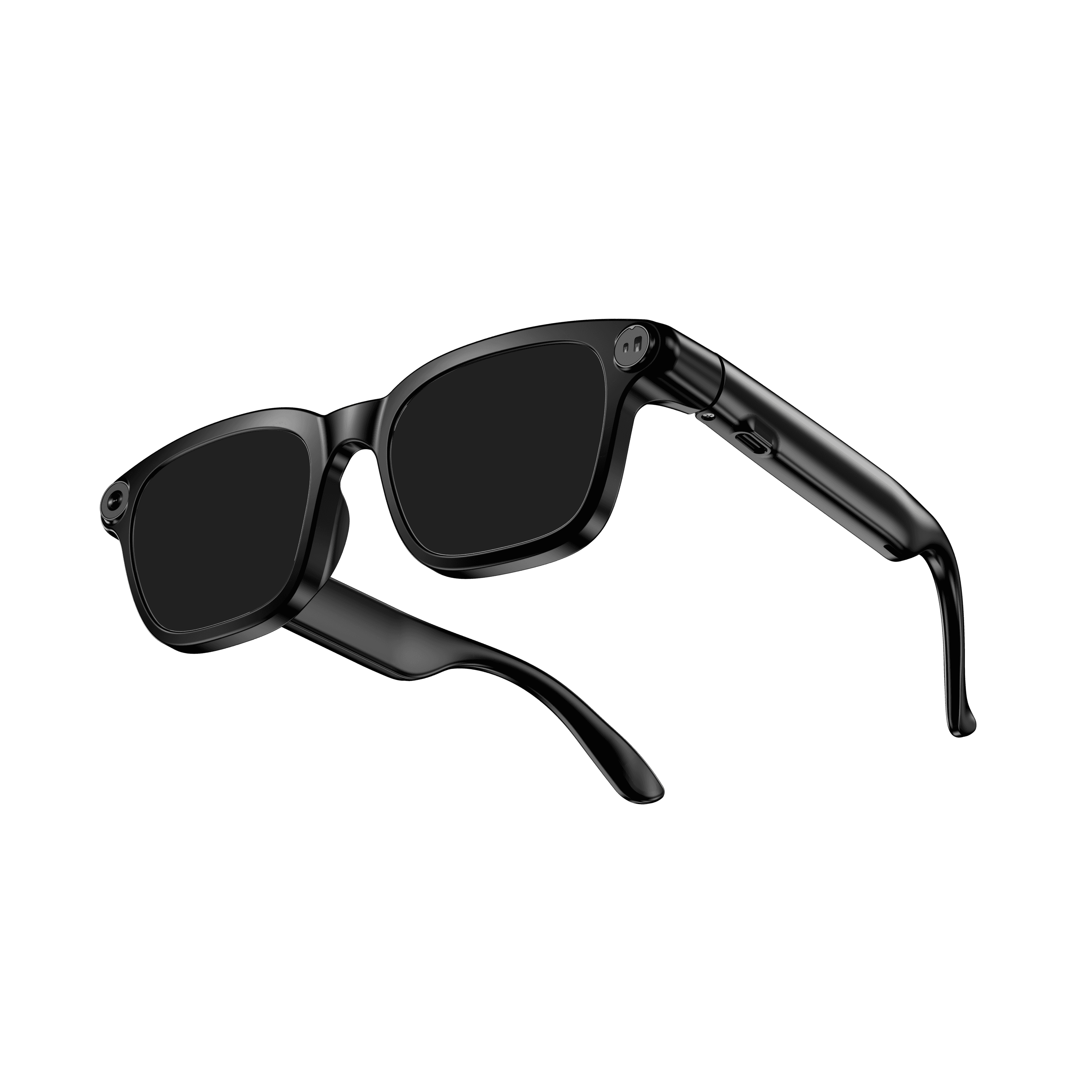 OXIVUE M08$99 at checkout | 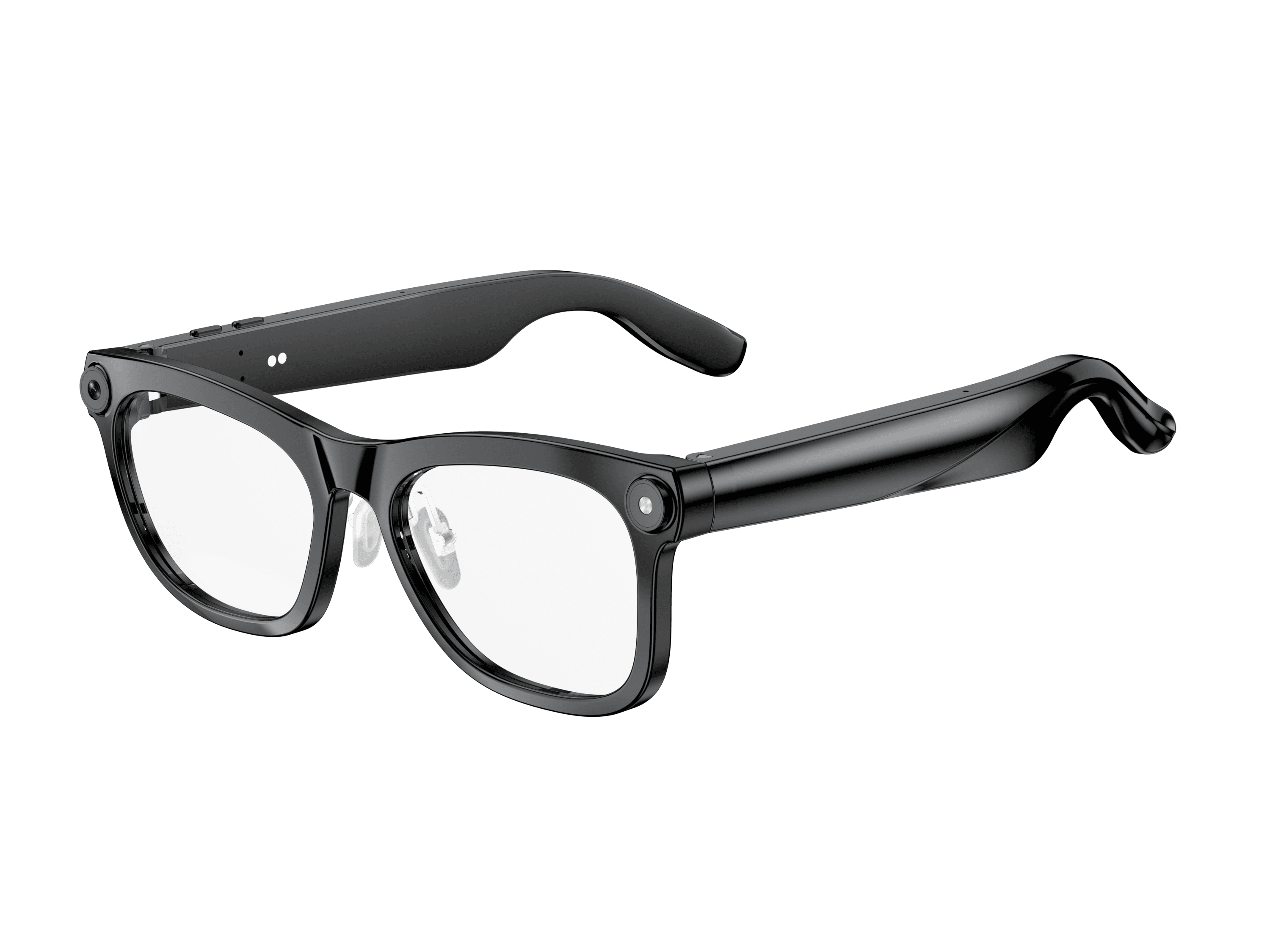 OXIVUE M02C$109 at checkout | 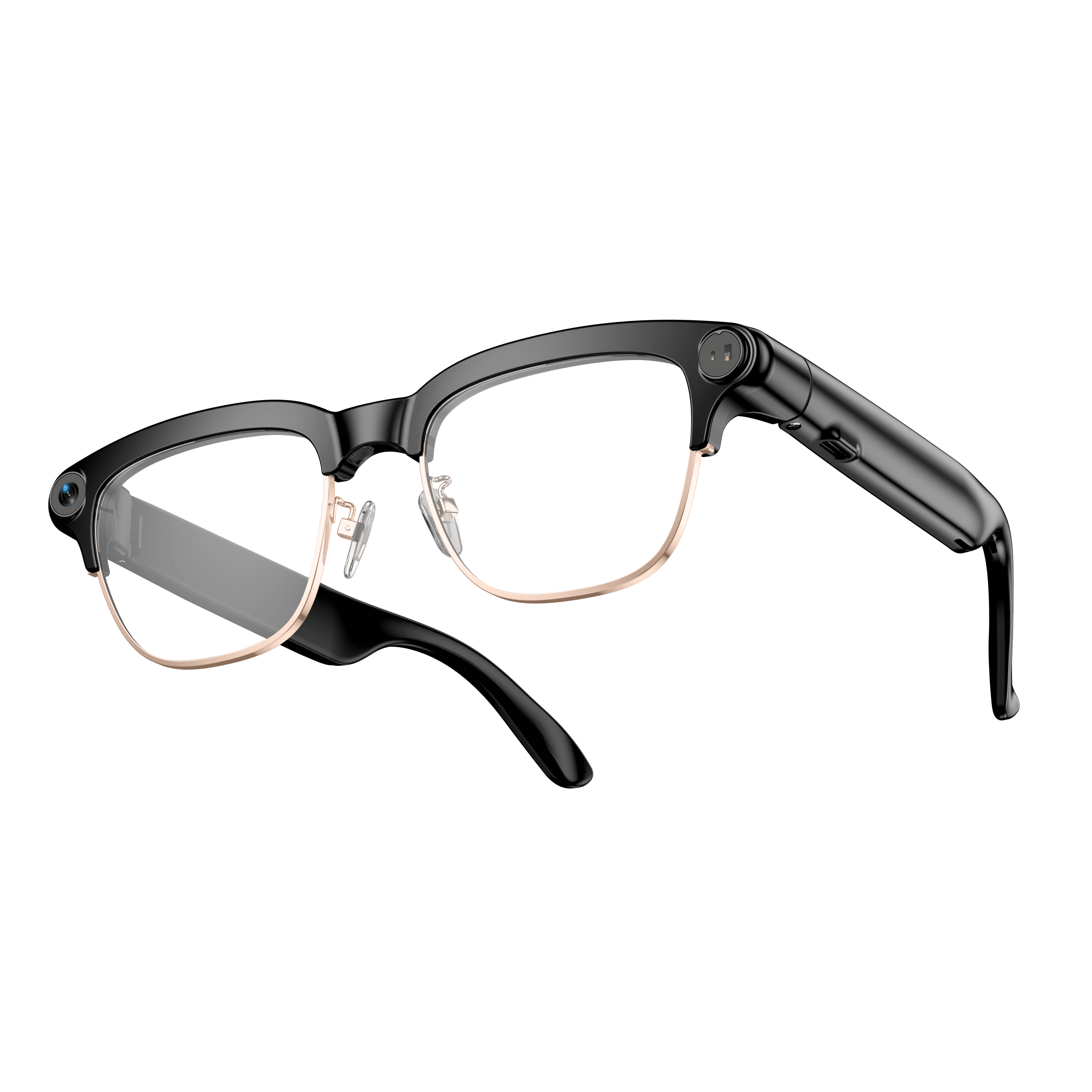 OXIVUE M08C$119 at checkout | |
|---|---|---|---|
| Camera | 8 MP | 8 MP | 8 MP |
| Weight | ~42 g | ~41 g | ~42 g |
| Water rating | — | IP65 | — |
| Lenses | Sunglasses · Photochromic · Clear | Sunglasses · Photochromic · Clear | Sunglasses · Photochromic · Clear |
| Translation | 40+ languages | 40+ languages | 40+ languages |
| Visual AI | — | Yes | — |
| Metal trim | — | — | Gold · Silver |
From each frame’s product page. Every model: open-ear audio, Bluetooth 5.4, no subscription. Full spec table
What these frames won’t do
- No prescription lenses yet, on any model. If you need vision correction all day, these can't replace your glasses.
- No display. Nothing appears in your view; you hear answers and capture photos and video.
- Open-ear speakers leak some sound at high volume and won't block out a loud train or a windy road the way sealed earbuds do.
- Translation, music, calls and the assistant need your phone nearby and connected. Translation pauses after each sentence, and only you hear the translated audio; the other person reads the reply on your phone.
- M08: no published water rating, so keep it out of heavy rain and spray.
Check these before you order: see the warranty and refund policy.