Autofocus lenses · 2026
Autofocus smart glasses: what has actually been published
Search for autofocus smart glasses and you meet three different ideas: lenses that refocus your eyes by themselves, a camera that focuses its picture, and marketplace listings carrying the same label. This guide sorts them out from what makers and named outlets have published, with dates, and says plainly where OXIVUE does not belong.
Still deciding? Get the M02C, M08 and M08C comparison in your inbox, with your new-customer price already applied.
One email with the comparison, one follow-up a few days later. Unsubscribe any time.
1. What autofocus glasses are meant to do
Autofocus glasses are corrective eyeglasses that aim to change their focus automatically as you look from far to near, so that one pair stands in for reading glasses, bifocals or progressive lenses. That is how Dezeen (checked October 31, 2026) describes IXI’s product: a substitute for traditional multifocal or reading glasses, with the near-vision correction switching on only when the wearer looks at close objects.
Dezeen says the product is targeted at people with presbyopia. Both outlets describe lenses whose focus is switched by eye tracking. Dezeen says the lenses use liquid-crystal technology and that the crystals, when activated, twist into a position that emulates the shape of a traditional convex lens. It says activation happens automatically through eye tracking that recognises the subtle convergence of the eyes, using LEDs rather than the camera-based systems in contemporary VR headsets, which it says require a lot of computing power. Engadget describes built-in eye tracking and LCDs that can automatically focus on whatever you look at. It also reports CEO Niko Eiden’s claim that the tiny batteries in the thin frames can last a day of usage, with the assumption that wearers charge them overnight by connecting a cable near the temple.
Everything in the paragraph above is what the two outlets wrote about the maker’s design, or claims they relayed, not a test result. These are vision-correction products, so whether any of them suits you is a question for an eye-care professional. We make no claims about vision outcomes, and nothing on this page is eye-care advice.
2. Which autofocus glasses exist: a dated status table
In the articles we could read on October 31, 2026, the autofocus eyeglasses that Engadget and Dezeen covered were a product not yet shipping (Engadget) and a working prototype (Dezeen). The table uses three status words: “reported” means a named outlet said it, “unverified” means we could not confirm it ourselves, and “not evaluated” means we did not assess the claims.
| Item | What the source says | Source and date | Status |
|---|---|---|---|
| IXI Adaptive Eyewear: availability and price | Not shipping yet; no pricing or availability announced; the CEO expects a price in the “high end of existing glasses” range | Engadget, September 26, 2025 | Reported by Engadget; the price expectation is the CEO’s |
| IXI: design and prototype | A working prototype of 22 g; launch styles named as one square and one round frame; planned sale through opticians; prescription range, price, launch date and regulatory status not described | Dezeen, November 18, 2025 | Reported |
| IXI: funding and stage | $36.5M Series A led by Plural; funding to complete development and launch commercial operations; pilots tested prototypes | Tech Funding News, April 29, 2025 | Reported |
| IXI: the maker’s own current status | Our automated check of ixieyewear.com was refused on October 31, 2026 (HTTP 429) | — | Unverified; check the maker’s site |
| “Auto focus” reading glasses on marketplaces | Appear in the Google results for this search; we have not tested any and quote none of their claims or prices | Google results, October 31, 2026 | Not evaluated |
Read each row for the kind of statement it is. A chief executive’s expectation of a price range is not a price. The weight of a prototype is not the weight of a production pair. Funding is not approval, and a marketplace listing is not a test. None of that is a reason to dismiss the technology; it is a reason to wait for the maker’s own statement before you plan a purchase around it.
The honest reading is narrow. The press we read covers one company in detail, and its most recent article we could open is from November 2025. We could not load the maker’s own page, so we cannot tell you whether anything has changed since. If a store or an advert tells you autofocus eyeglasses are available now, ask for the maker’s name and regulatory status and compare it with what the maker publishes.
3. IXI: what has and has not been said
IXI, a Finnish company as Engadget and Dezeen describe it, is the name that recurs in the coverage we read. In what follows each point is dated and attributed to the outlet.
- Funding.Tech Funding News (April 29, 2025) reported a $36.5M Series A led by Plural, which it says will let IXI “complete the development of IXI Adaptive Eyewear” and launch commercial operations.
- Stage. Engadget (September 26, 2025) said IXI was not yet ready to ship and that, by acquiring the lens manufacturing unit of Finnsusp, it would be able to begin low-volume production for in-house testing, with a partnership with OptiSwiss expected to help it scale.
- Design. Dezeen (November 18, 2025) described a 22 g working prototype, two launch frame styles, interchangeable nose pieces, and a plan to sell through existing opticians.
- Price.Engadget reported only the CEO’s expectation of the “high end of existing glasses”. Dezeen (checked October 31, 2026) does not describe a price, and Tech Funding News does not mention one.
- Regulation. Engadget (checked October 31, 2026) does not mention regulatory approval or clearance, and Dezeen does not describe it either.
That list is a snapshot of three articles, not a verdict on the product. A prototype can change before sale, and the dates matter: the newest of the three pieces is close to a year old on the day we checked it.
4. The “auto focus” marketplace listings in the results
We cannot confirm that auto focus reading glasses from marketplace sellers work, and we have not tested any. Several results for this search (checked October 31, 2026) are listings on Amazon, Walmart and eBay for “auto focus” or “self-adjusting” glasses. They are sales pages, so any wording on them is the seller’s own claim, and we quote none of it or of their prices.
A few questions help you judge any of them. Does the listing name the company that makes the lens? Does it say what technology adjusts the focus? Can you look up the product’s regulatory status? If the only evidence is the listing’s own copy, treat the claim as unverified. And if you are unsure what correction you need, an optician’s exam answers it better than any product page can.
5. Three different things called “auto”
Three unrelated features get lumped together under “autofocus smart glasses”: lenses that refocus your eyes, a camera that focuses its image, and lenses that darken in sunlight. The labels overlap on shop pages, which is why the search is confusing.
| Feature | What it changes | Does OXIVUE have it? |
|---|---|---|
| Autofocus lenses | The focus power of the lens in front of your eye, between near and far | No; none of our frames take prescription lenses |
| Camera focus | How sharp a photo or clip is at different distances | We publish no camera-focus specification, so we make no claim |
| Photochromic tint | How dark the lens is, depending on UV light | Yes, as an M08, M02C or M08C lens choice; close to clear indoors |
Photochromic lenses change brightness, not focus. If tint is what you are really after, read our guide to photochromic smart glasses. A camera on glasses captures an image; it does not change what your eyes see. Our guide to how AI glasses work explains the parts.
6. If you need help seeing near and far today
The established route is an eye exam and the lens types an optician already sells, such as reading glasses, bifocals and progressive lenses. Dezeen (checked October 31, 2026) calls bifocal, varifocal or progressive lenses the established solution and describes IXI’s design as a substitute for traditional multifocal or reading glasses, so those are the benchmark any autofocus product is measured against.
If you already wear prescription lenses and want smart-glasses features, you have to look at makers that offer a prescription option. Our guide to prescription smart glasses covers the field, and prescription options on Meta’s glasses covers one maker in detail. OXIVUE is not on that list. If you want a display instead, see smart glasses with a display; a display is also a different thing from autofocus.
7. Where OXIVUE fits: it does not do autofocus
OXIVUE has no autofocus lenses, no prescription lenses and no display. What the frames do is smaller and simpler. They are camera and audio glasses for people who want to capture what they see with a touch, take calls and play music through open-ear speakers, and translate through a phone app.
- M08, $99 at checkout (listed $149). About 42 g, with an 8 MP camera, Bluetooth 5.4, 7 hours of listening and 4 hours of calls, and translation in 40+ languages through the free companion app. The lens comes in sun, photochromic or clear; the photochromic lens darkens in UV light and turns close to clear indoors.
- M02C, $109 at checkout (listed $159). About 41 g, with a Sony IMX219 8 MP sensor, dual stabilisation, IP65 (dust and water jets, not immersion), magnetic charging and a voice-activated visual assistant that can describe what you are looking at. OXIVUE does not publish which AI model powers the M02C’s voice-activated visual assistant.
Translation runs through your phone: the translated audio is heard only by you, the other person reads the reply on the phone, and translation pauses after each sentence. Capture starts only with a visible touch on the temple, so ask before recording people and follow local law. Two or more pairs in one order are 50% off all eyewear. The comparison page lays every model side by side. These frames are not for anyone who needs lenses that correct vision or refocus, or glasses that show text in their field of view.
Shipping, refunds and warranty. Free shipping from $99. US orders typically arrive in 5–9 business days. International orders take 9–14 business days after shipment. Import VAT or duties outside the US are paid by the recipient. No refunds except transit damage (replaced or refunded); faults are repaired or replaced under the 2-year warranty; change of mind and unmet expectations are not refundable. None of our frames take prescription lenses. Details on the shipping policy page. Read the refund policy before you order.
Frequently asked questions
Do auto focus glasses work?
We cannot confirm that they do. Engadget (September 26, 2025) reported that IXI's autofocus glasses were not shipping yet, and Dezeen (November 18, 2025) described a working prototype without giving a price, launch date or regulatory status. Neither article (checked October 31, 2026) describes independent test results; Engadget's piece draws on an interview with the CEO. Check IXI's own site and talk to an eye-care professional before relying on any autofocus claim.
Do auto focus reading glasses work?
We have not tested any and cannot confirm it. The Amazon, Walmart and eBay listings that appear for this search (checked October 31, 2026) are sales pages, so we quote neither their claims nor their prices. Look for a named maker, a stated lens technology and a regulatory status you can verify, and ask an optician if you are unsure. OXIVUE sells no reading glasses and no autofocus lenses.
How much do IXI autofocus glasses cost?
No price has been announced in the sources we read. Engadget (September 26, 2025) reported that IXI's CEO expects the glasses in the 'high end of existing glasses' price range, with no pricing or availability announced. Dezeen (November 18, 2025) gave no price either. We could not load IXI's own site on October 31, 2026, so check ixieyewear.com for the current position.
What can smart AI glasses do?
AI glasses of the kind OXIVUE makes combine a camera, microphones, open-ear speakers and, on some frames, a voice assistant in an ordinary-looking pair of frames. On the M08 that means an 8 MP camera, calls and music through open-ear speakers, and translation in 40+ languages through the free companion app, with a touch on the temple to start a capture. There is no display and no prescription option. Autofocus lenses are a separate category of product.
Can I use ChatGPT on smart glasses?
That depends on the glasses and is for their maker to state. OXIVUE does not publish which AI model powers the M02C's voice-activated visual assistant, and this page makes no claim about any named assistant on any OXIVUE frame. For another maker's glasses, check that maker's own pages for supported assistants, regions and subscriptions before you buy.
Do OXIVUE glasses have autofocus or take my prescription?
No on both. OXIVUE has no autofocus lenses, and none of our frames take prescription lenses. The M08 comes in sun, photochromic and clear lenses; the photochromic lens darkens in UV light and turns close to clear indoors, which changes tint, not focus. OXIVUE publishes no camera-focus specification for any frame, so we say nothing about how the cameras focus.
OXIVUE frames side by side
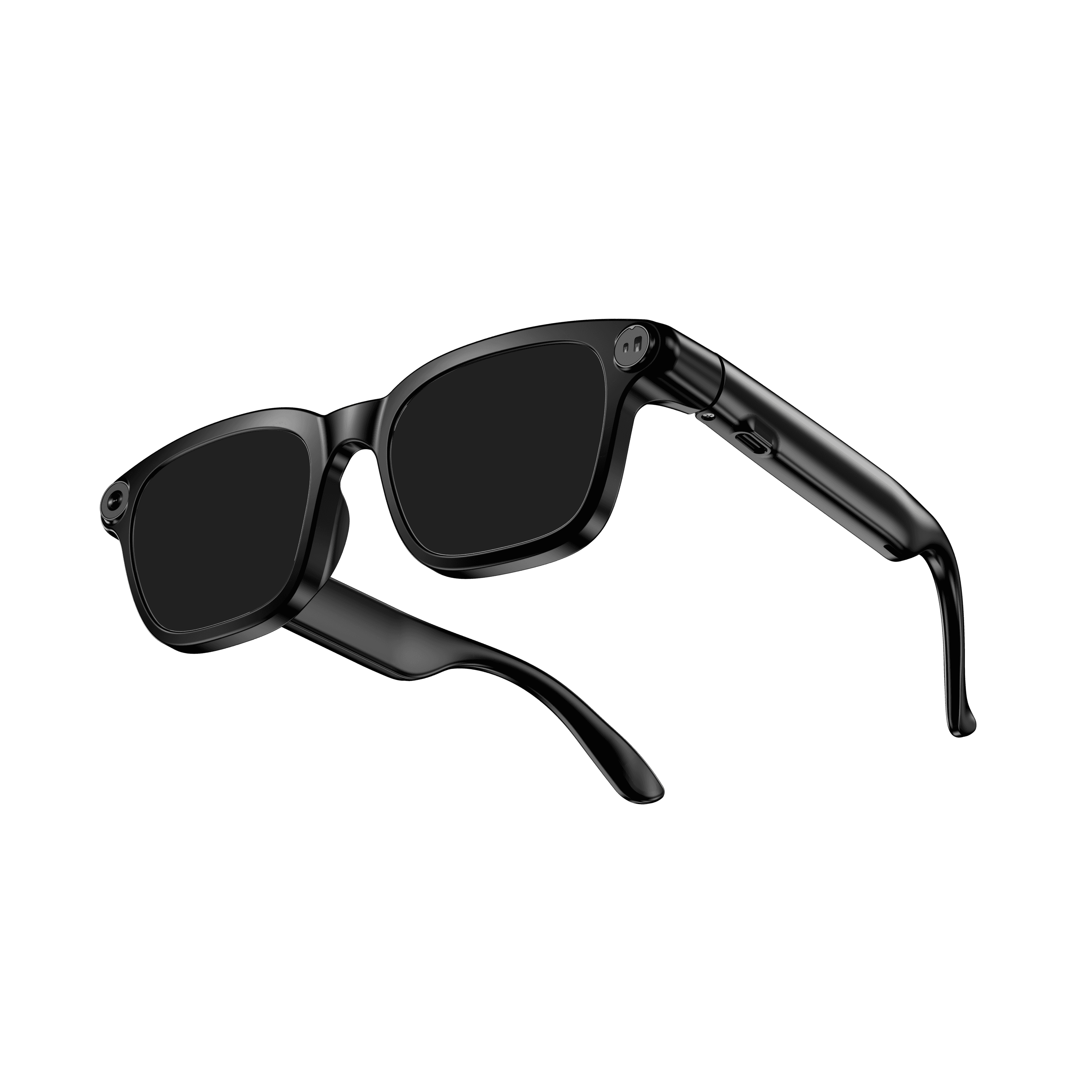 OXIVUE M08$99 at checkout | 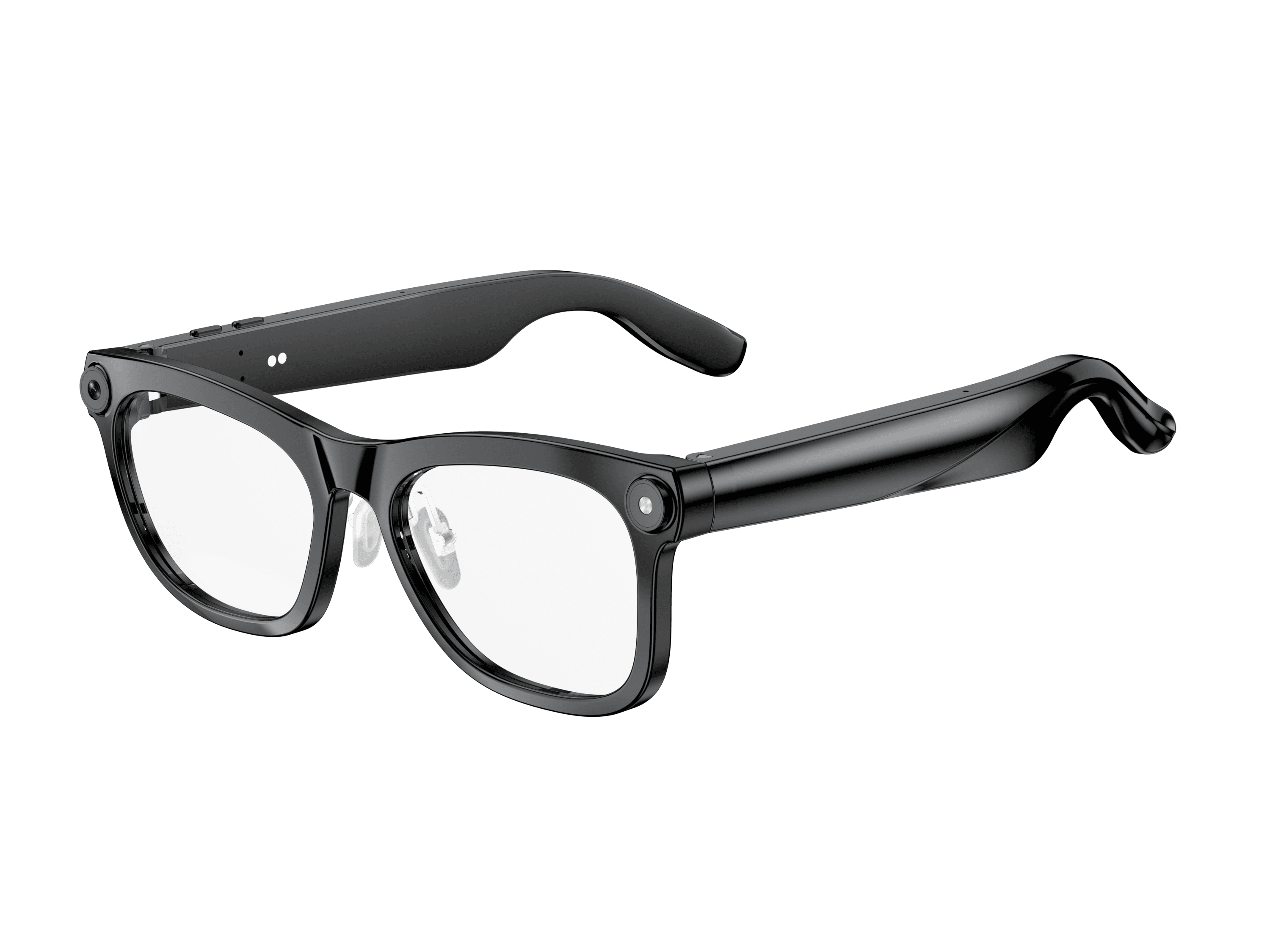 OXIVUE M02C$109 at checkout | 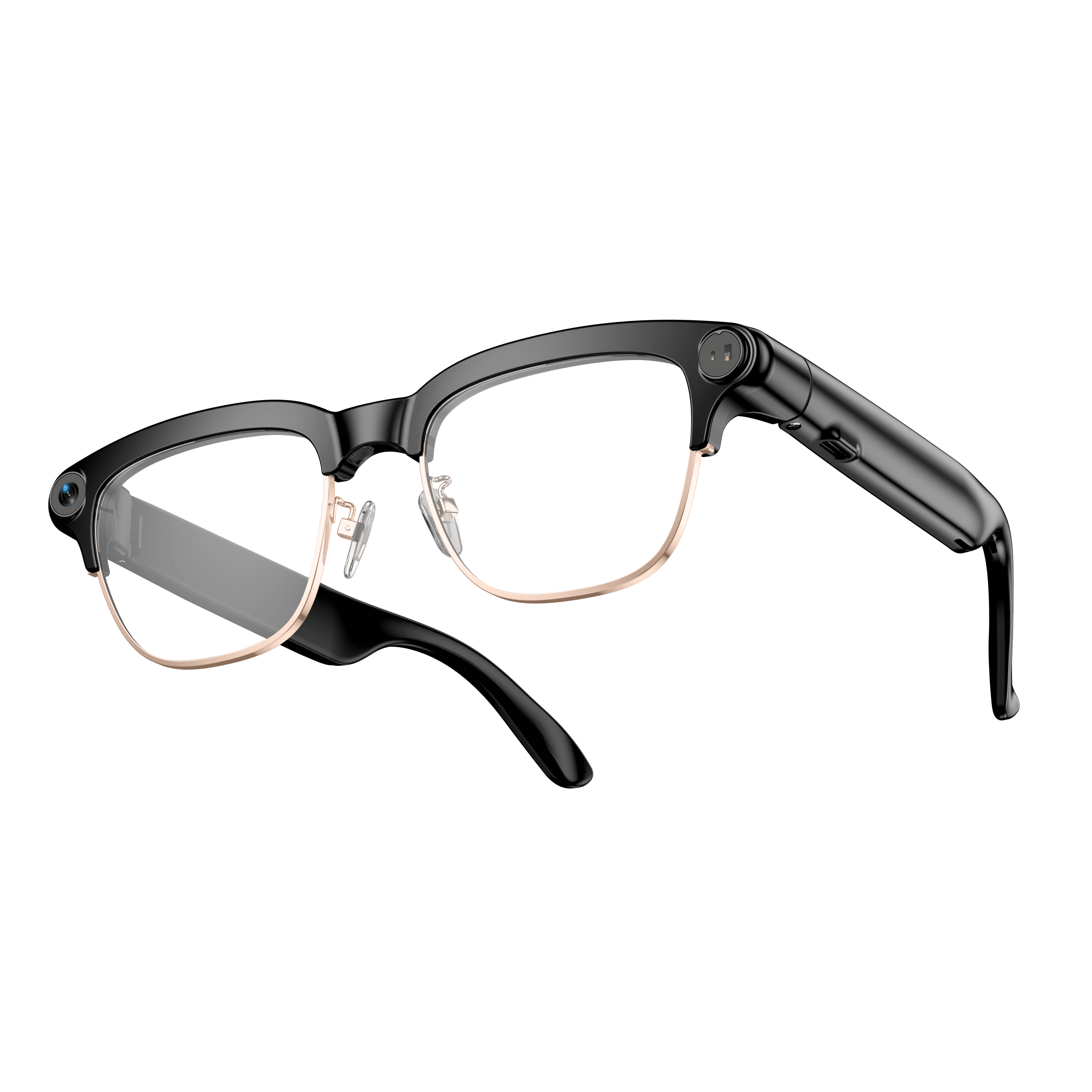 OXIVUE M08C$119 at checkout | |
|---|---|---|---|
| Camera | 8 MP | 8 MP | 8 MP |
| Weight | ~42 g | ~41 g | ~42 g |
| Water rating | — | IP65 | — |
| Lenses | Sunglasses · Photochromic · Clear | Sunglasses · Photochromic · Clear | Sunglasses · Photochromic · Clear |
| Translation | 40+ languages | 40+ languages | 40+ languages |
| Visual AI | — | Yes | — |
| Metal trim | — | — | Gold · Silver |
From each frame’s product page. Every model: open-ear audio, Bluetooth 5.4, no subscription. Full spec table
What these frames won’t do
- No prescription lenses yet, on any model. If you need vision correction all day, these can't replace your glasses.
- No display. Nothing appears in your view; you hear answers and capture photos and video.
- Open-ear speakers leak some sound at high volume and won't block out a loud train or a windy road the way sealed earbuds do.
- Translation, music, calls and the assistant need your phone nearby and connected. Translation pauses after each sentence, and only you hear the translated audio; the other person reads the reply on your phone.
- M08: no published water rating, so keep it out of heavy rain and spray.
Check these before you order: see the warranty and refund policy.