Privacy · face recognition · 2026
Smart glasses with facial recognition: what actually exists
Reports in 2026 that Meta is working on facial recognition for its glasses made this a common question. This guide sets out, with dates and sources, what Meta has and has not said, what OXIVUE glasses list, and what consent and privacy mean for anyone wearing camera glasses or standing in front of them.
Still deciding? Get the M02C and M08 comparison in your inbox, with your new-customer price already applied.
One email with the comparison, one follow-up a few days later. Unsubscribe any time.
1. The short answer
Meta’s own statements, as reported through August 2026, say no face-identification feature has launched on its glasses. Meta is the biggest name in the category, so most searches for this topic are really about it. The rest of this page keeps what is reported separate from what is confirmed, because the two are easy to blur in headlines.
Two different things get called facial recognition. The first is face detection: noticing that a face is in the frame, for example so it can be blurred or so a photo is framed well. The second is face identification: matching a face to a name or an identity. The question people are asking is almost always the second one. Wherever a company says something about it, the exact wording matters.
Other makers and apps may handle this differently, and we have not tested them. This guide makes claims only about what Meta has said and what OXIVUE lists.
2. What Meta has said, with dates
Meta’s official AI glasses privacy page does not mention face recognition. The page (meta.com/ai-glasses/privacy, checked November 12, 2026) says that when you ask Meta AI about something in view, “faces and license plates are automatically blurred if they appear in the frame” and the images used to answer are not saved to your gallery. It also says the glasses are “active on your command only.” The rest of the story comes from press reports and Meta’s replies to them:
- February 13, 2026. The New York Times reported, as relayed by MacRumors (checked November 12, 2026), that Meta was planning a feature internally called “Name Tag.” Meta did not confirm the plans. Its statement, as MacRumors reports it, was that it is “still thinking through options and will take a thoughtful approach if and before we roll anything out.” The report said Meta was still working out who could be recognised and that the feature would not let users look up just anyone.
- June 5, 2026.WIRED reported unreleased code for a feature called “NameTag” inside Meta’s AI companion app. As 9to5Google reports it (checked November 12, 2026), a Meta spokesperson said: “Nothing has shipped to consumers and no final decision has been made on what to do here, if anything,” and “we are not building a central face database.”
- July 9, 2026. Meta CTO Andrew Bosworth discussed the idea in an interview. Social Media Today (checked November 12, 2026) reports he described it as being explored mainly to help visually impaired users know who is in the room, using people met in person and stored locally on the device, rather than a global database of faces. The article also says Meta had removed facial ID elements from back-end code after the WIRED report.
- August 16, 2026. Biometric Update (checked November 12, 2026) covered a Meta patent published August 13, 2026 that describes an assistant using facial recognition among other signals. It notes Meta called NameTag “exploratory” and that the feature had not launched. A patent is not a product.
Read together: reports of work on the idea, replies from Meta that nothing has shipped and no final decision has been made, and no launch in the sources we could read. We found no coverage newer than August 2026, so check Meta’s own pages for the current position. For how Meta handles your voice, photos and account data more broadly, see our Meta glasses privacy guide.
3. The 2024 student demonstration
The 2024 demonstration was a modified pair of glasses, not a Meta feature. In October 2024, two Harvard students showed a project called I-XRAY, built on commercially available Meta Ray-Ban glasses and outside services, that could connect a face to personal details found online. 404 Media reported it on October 2, 2024 (read November 12, 2026), and said the students were not releasing their code and framed it as a warning about what is possible.
We are not describing how it worked, and nothing here is a method. The point for a buyer is narrower: the recognition in that demonstration was not in the glasses. It ran on separate services. A camera on your face can feed software that the maker did not ship, which is one more reason the rules about consent sit with the wearer, not the hardware.
4. What OXIVUE glasses list
OXIVUE lists no face-recognition or face-identification feature for any of its frames. We checked the product specifications. The M02C carries a voice-activated visual AI that answers questions about what you are looking at. The M08 and M02C have an 8 MP camera, open-ear speakers and microphones, and translation in the free companion app. Neither has a display, and none of our frames take prescription lenses.
One honest limit: the M02C’s visual AI is a general answering feature, and we do not publish how it treats a face in the frame. We do not list or promise that it identifies anyone, and we do not sell any frame as a way to find out who someone is. The comparison below is limited to what each source actually states.
| Meta AI glasses (per Meta’s pages and statements) | OXIVUE M08 / M02C | |
|---|---|---|
| Face-identification feature | Not launched; Meta says nothing has shipped and no final decision has been made (June 2026) | None listed in the product specs |
| How a capture starts | By the wearer, with a voice command or button tap, per Meta’s privacy page | A deliberate touch on the temple |
| Faces in AI answers | Meta says faces and license plates are blurred when you ask Meta AI about what you see | M02C visual AI answers questions about what you look at; treatment of faces not published |
| Display | Not covered by this page | None |
| Price at checkout (one pair) | Not covered by this page | M08 $99 · M02C $109 |
OXIVUE prices checked 2026-11-12; checkout price may change. The M08 is listed at $149 and the M02C at $159; a single pair settles at $99 and $109 at checkout. Free shipping starts at $99. Compare every frame on the comparison page.
5. How capture works on a pair of camera glasses
On OXIVUE frames, nothing is captured until the wearer touches the temple. The camera sits flush in the frame corner and is started by that touch. That is a design fact, not a privacy guarantee: a person wearing the frame decides when to capture, and a photo of a face is still a photo of a face. We publish no recording-indicator light specification for the M08 or M02C, so do not rely on spotting a light to know whether you are being filmed.
- Files go to the phone. Photos and clips are transferred to the companion app. With no display, you look at them on your phone.
- The assistant runs through the companion app.The M02C’s visual AI and translation use the companion app on your phone, so read the companion app’s privacy policy before you use them. Neither frame has a display, so there is no screen on the glasses themselves.
- No Meta, Facebook or Instagram account is needed to use the companion app with OXIVUE frames.
6. Consent and the law
Owning camera glasses is legal in the US; how you use them is what the law looks at. Video of what anyone can see in public is generally lawful in the US. Audio is different: wiretap laws apply, and some states need everyone in a private conversation to agree. Our recording laws by state guide goes through it, and the Europe guide covers the EU.
Identifying a person from their face is a separate question from photographing them. Laws on face data vary by country and by state, so check the rules where you live. We do not offer a face-matching feature, and we would not advise matching a stranger’s face to a name. This is general information, not legal advice.
Good practice for wearers is short: capture deliberately, say what the glasses are when asked, take them off in restrooms, changing rooms, clinics and other people’s homes, and ask before recording a conversation. If a venue or employer bans camera devices, that rule applies whatever the law allows. For people who rely on visual AI to describe their surroundings, see our guide for blind and low-vision users, which sets out what the M02C can and cannot do.
7. If you are the person being filmed
The most reliable step on any brand is to ask. Smart glasses look like ordinary eyewear, makers differ on whether they publish an indicator light, and a light does not tell you what happens to a capture afterwards. Ask the wearer whether the glasses are recording and what they are for. You are entitled to ask someone to stop pointing a camera at you, and to move away.
In shops, gyms, workplaces and private homes, the venue or host sets its own rules. If you think someone has recorded or identified you unlawfully, speak to a local legal adviser or the relevant authority; do not confront them in a way that puts you at risk.
Shipping, refunds and warranty. Free shipping from $99, so every single pair qualifies. US orders typically arrive in 5–9 business days; international orders take 9–14 business days after shipment, and import VAT or duties outside the US are paid by the recipient. No refunds except transit damage (replaced or refunded); faults are repaired or replaced under the 2-year warranty; change of mind and unmet expectations are not refundable. None of our frames take prescription lenses. Questions before you buy? Visit support.
Frequently asked questions
Do smart glasses have facial recognition?
Not according to what Meta has said. As reported by 9to5Google on June 5, 2026, a Meta spokesperson said that nothing has shipped to consumers and no final decision has been made, after WIRED reported unreleased code for a feature called NameTag. Other makers and apps differ, so check each product's own feature list. OXIVUE lists no face-recognition or face-identification feature for the M08 or M02C, and we do not market glasses as a way to identify people.
Can smart glasses record people?
Yes. Any camera glasses can photograph or film whoever is in front of the wearer, which is why consent and local law matter. OXIVUE frames start a photo or clip only with a deliberate touch on the temple, so nothing is captured unless the wearer starts it. Video in public is generally lawful in the US, while audio can fall under wiretap rules that sometimes need everyone's consent. This is general information, not legal advice.
Is it legal to use facial recognition with smart glasses?
It depends on where you are and what is done with the result. Laws on face data vary by country and by state, so check the rules where you live. Taking a photo is not the same as identifying someone. We do not give legal advice, so check the law where you live before using any face-matching service.
Does the OXIVUE M02C identify people it looks at?
We do not list that. The M02C has a voice-activated visual AI that answers questions about what you are looking at, and its specs list no face-recognition or face-identification feature. We do not publish how the visual AI treats a face in the frame, so if that matters to your decision, ask before you buy through the support page. The M02C is $109 at checkout (listed $159).
Do Meta glasses blur faces?
In one case, yes. Meta's AI glasses privacy page, checked November 12, 2026, says faces and license plates are automatically blurred if they appear in the frame when you ask Meta AI about what you see, and that the images used for the answer are not saved to your gallery. It describes that for Meta AI queries, not for photos and videos you capture yourself.
What should I do if someone is filming me with smart glasses?
Ask. Smart glasses look like ordinary eyewear, and the simplest test on any brand is to say so and ask the wearer whether they are recording. You can ask them to stop, move away, or leave the space, and in private venues such as shops, gyms and workplaces the owner's rules apply as well. If you believe a law has been broken, speak to a local legal adviser or the relevant authority.
Are there smart glasses without a camera?
Yes, but we only describe our own range. OXIVUE lists the M01 Pro as an audio-only frame with no camera, currently pre-order only. Our camera frames, the M08 at $99 and the M02C at $109 at checkout, have an 8 MP camera and no display. If a camera is the issue at your workplace or in your home, choose a frame without one, or ask before wearing a camera frame.
OXIVUE frames side by side
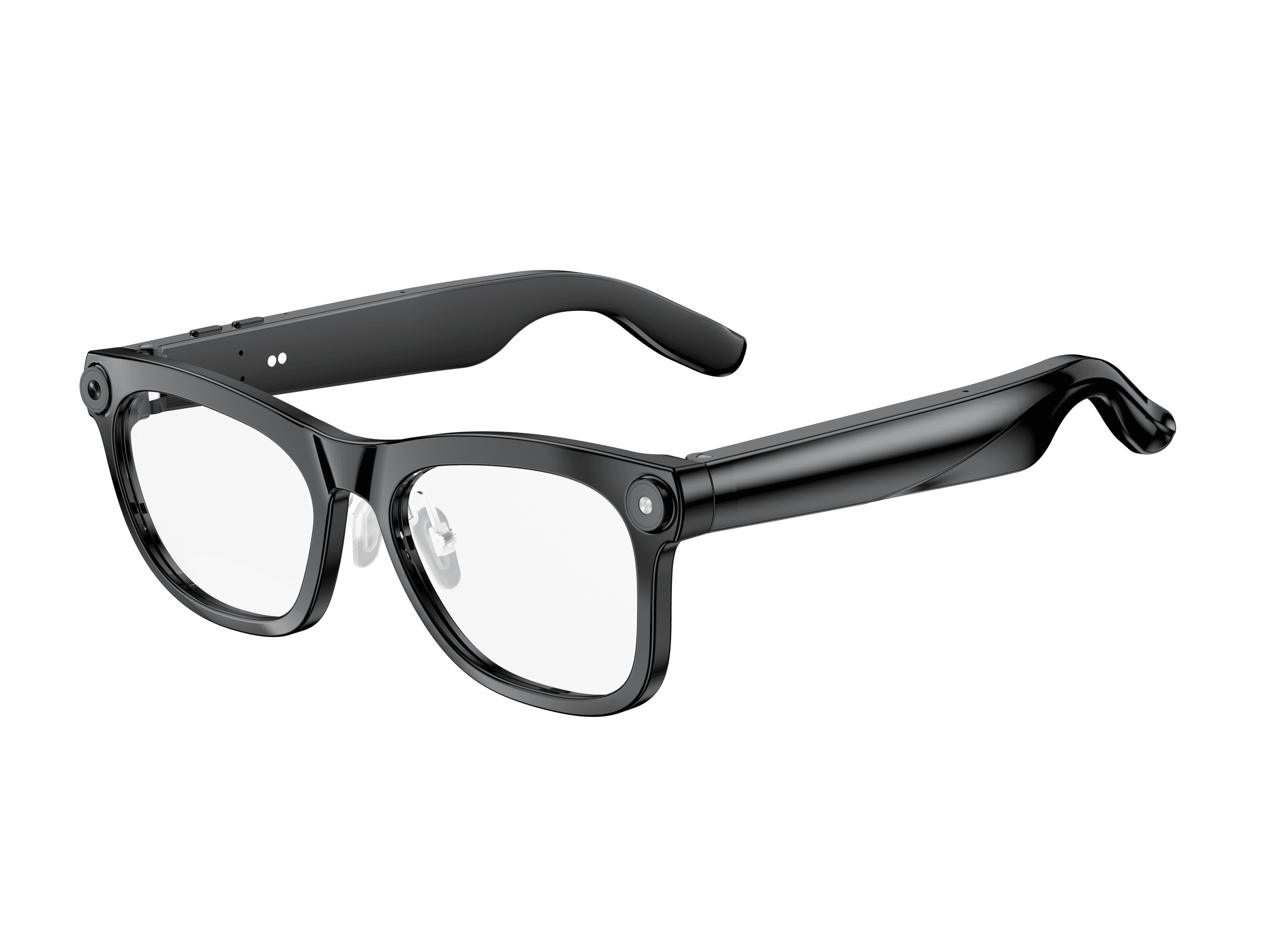 OXIVUE M02C$109 at checkout | 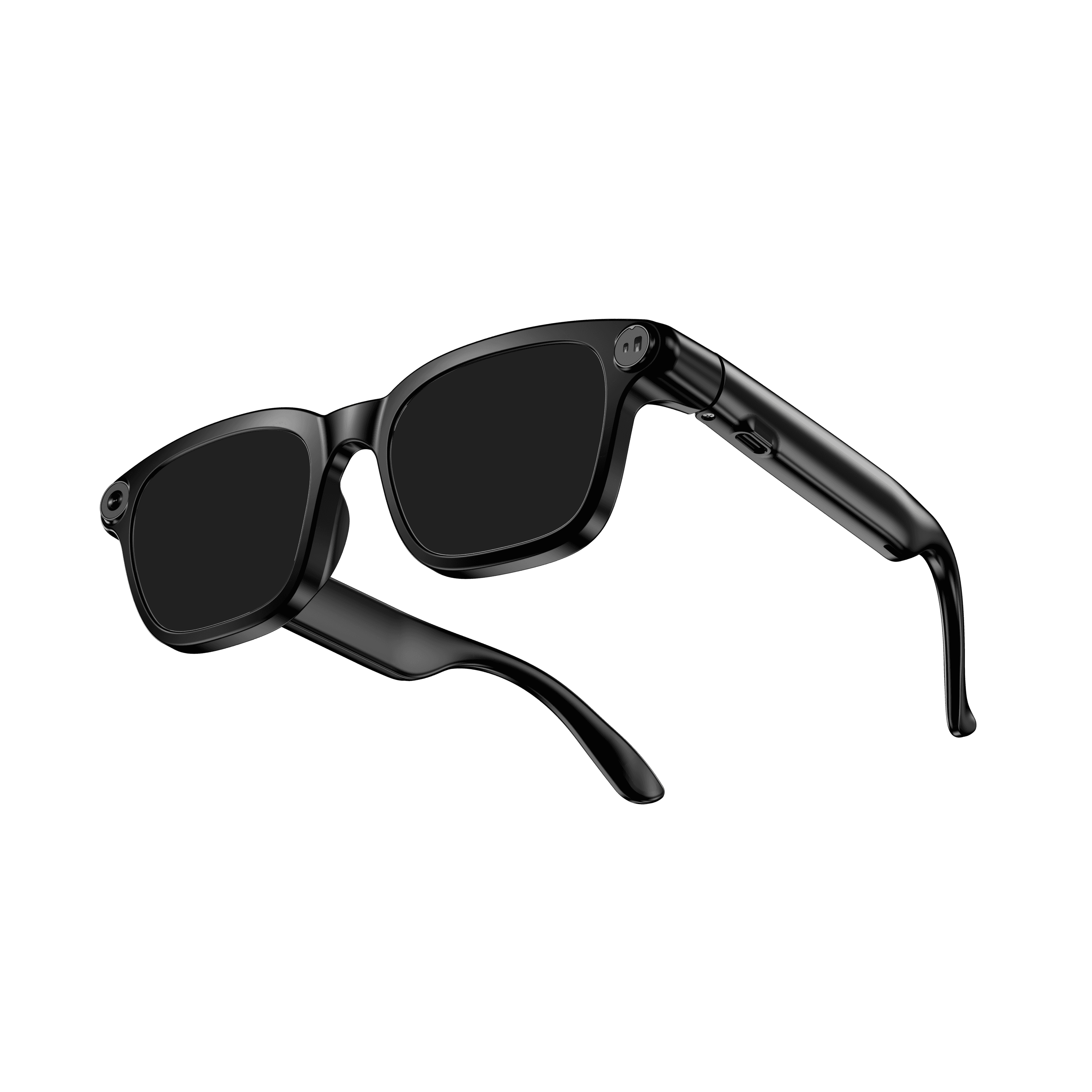 OXIVUE M08$99 at checkout | |
|---|---|---|
| Camera | 8 MP | 8 MP |
| Weight | ~41 g | ~42 g |
| Water rating | IP65 | — |
| Lenses | Sunglasses · Photochromic · Clear | Sunglasses · Photochromic · Clear |
| Translation | 40+ languages | 40+ languages |
| Visual AI | Yes | — |
From each frame’s product page. Every model: open-ear audio, Bluetooth 5.4, no subscription. Full spec table
What these frames won’t do
- No prescription lenses yet, on any model. If you need vision correction all day, these can't replace your glasses.
- No display. Nothing appears in your view; you hear answers and capture photos and video.
- Open-ear speakers leak some sound at high volume and won't block out a loud train or a windy road the way sealed earbuds do.
- Translation, music, calls and the assistant need your phone nearby and connected. Translation pauses after each sentence, and only you hear the translated audio; the other person reads the reply on your phone.
- M02C: IP65 resists dust and water jets, not immersion. No swimming, no saltwater.
- M08: no published water rating, so keep it out of heavy rain and spray.
Check these before you order: see the warranty and refund policy.