Assistants · Siri
Siri glasses: what works with Siri today, and what Apple has actually said
Searching for Siri glasses can mean one of two things: a pair you can wear today that answers to Siri, or Apple’s own glasses. This guide separates them. It quotes each maker’s own pages, dates every claim, and labels what Apple has announced, what outlets have reported and what we found no announcement of.
Still deciding? Get the M08 and M02C comparison in your inbox, with your new-customer price already applied.
One email with the comparison, one follow-up a few days later. Unsubscribe any time.
1. Which smart glasses work with Siri today?
A pair of glasses works with Siri when it passes your voice to your iPhone and the iPhone’s assistant answers. Of the makers whose pages we read on October 31, 2026, Lucyd is the one that says so. Its homepage FAQcalls Lucyd “AI-agnostic” and says you can use Siri, Google Assistant, Lucyd AI or ChatGPT through your phone’s own integration. It lists Bluetooth pairing with iOS 13 or later and Android 8 or later, and it describes its Aero, Armor, Lyte and Reebok glasses as camera-free. It also carries the HTC VIVE Eagle, which it calls a partner product sold with HTC, listed from $499 with 12MP (checked October 31, 2026).
Meta describes something different. Its AI glasses voice assistant page (checked October 31, 2026) says the glasses are “Powered by Meta AI” and that you start Meta AI by saying “Hey Meta” or by tapping and holding the touchpad. That page and Meta’s help article “Learn more about Meta AI on AI glasses” do not mention Siri. That is not proof that nothing can reach Siri, only that those pages do not describe it. Our guide to Meta glasses and iPhone covers what the Meta AI app asks of an iPhone.
Solos’ homepage (checked October 31, 2026) does not name Siri, ChatGPT or any other third-party assistant, and its “SolosChat” menu link is not described there, so the AirGo range needs a question to the maker before you assume anything. And Apple, the company behind Siri, has no glasses that we found on sale or announced; section 4 sets out what is announced and what is only reported.
2. How Siri reaches a pair of glasses, and the wake-word question
Glasses are not iPhones. Audio and camera glasses connect to the phone over Bluetooth. With a phone assistant such as Siri, the question is how the glasses signal the phone. Lucyd’s help page (checked October 31, 2026) is a clear description: on the Lyte, Reebok Optical and Aero, a double-tap on the right temple opens the phone’s assistant, “whichever one you have set as the default.” Its gesture table lists “Double tap right” as “Voice assistant” for the Lyte and Reebok Optical. The page does not use the word Siri. On an iPhone the built-in assistant is Siri, which is among the assistants Lucyd’s homepage names.
Whether a spoken wake word works is where the pages we read differ. Lucyd’s help page says the Aero has no wake word, while its app page(checked October 31, 2026) tells iPhone users to “Activate Siri on any wearable and say the wake word to start talking to AI” without naming the phrase. Neither page uses the words “Hey Siri”. Sony’s help page for its WF-H800 headphones, which are headphones rather than glasses but are also a Bluetooth accessory for an iPhone, says to press and hold the button on the right unit for about two seconds to start Siri, and that saying “Hey Siri” does not activate it through the headset, even with the iPhone’s setting on (checked October 31, 2026). That is one maker’s statement about one product. Read the manual for the pair you are considering before you assume a wake word.
Two practical points follow from these examples. The trigger the help pages describe is a touch or a button press, and one app page mentions a wake word without naming it, so ask what the trigger is and where it sits. And in Lucyd’s description it is the phone’s assistant that opens, so the assistant you get is the one on your phone. Our guide to smart glasses with a voice assistant compares which assistant lives in which frame.
3. What each maker’s own pages say about assistants
The table records only what each maker’s own pages state, all checked on October 31, 2026. A brand missing from it is one we did not check; that says nothing about the brand.
| Glasses | What the maker’s pages say about assistants | Siri named? | Where we read it |
|---|---|---|---|
| Lucyd (Aero, Armor, Reebok, Lyte) | Uses the phone’s own integration; homepage names Siri, Google Assistant, Lucyd AI and ChatGPT; a temple double-tap opens the phone’s default assistant; no wake word on the Aero (help page), while the app page mentions a wake word without naming it | Yes, on the homepage FAQ and the app page | lucyd.co, help.lucyd.co and lucyd.co/pages/lucyd-app |
| Meta AI glasses (the voice assistant page names Ray-Ban Meta and Oakley Meta) | Meta AI, started by “Hey Meta” or by tapping and holding the touchpad | Not on the two pages we read | meta.com voice assistant page and help article |
| Solos AirGo | Homepage does not name Siri, ChatGPT or another third-party assistant; a “SolosChat” menu link is not described | Not on the homepage | solosglasses.com |
| Apple | No glasses announcement found; no glasses item among the 20 newest newsroom items, and no glasses entry in the homepage navigation | Not applicable | apple.com newsroom feed and homepage |
| OXIVUE M08 and M02C | M02C: voice-activated visual assistant; OXIVUE does not publish which AI model powers it | No Siri claim | OXIVUE product pages |
4. What Apple has said about its own glasses
Announced: no announcement found. Apple’s newsroom feed (checked October 31, 2026) lists 20 items from September 29 to October 28, 2026, and none is about glasses; Apple’s homepage navigation, checked the same day, has no glasses entry. We found no announcement of an Apple glasses product, a price or a release date.
Reported: a fair amount, all of it reporting on unannounced plans.The four write-ups we read in full each relay Bloomberg’s Mark Gurman:
- Engadget, May 31, 2026: the glasses carry the codename N50. The plan to unveil them by the end of 2026 and ship in early 2027 has slipped, with launch now expected toward the end of 2027. Apple reportedly plans four styles, and the revamped Siri is expected to be part of the product.
- Digital Trends, May 31, 2026:the glasses reportedly depend heavily on a revamped Siri, which the outlet calls a recurring source of delay across Apple’s roadmap, and have oval-shaped cameras. It says Apple wants to target the $200 to $500 segment of the eyewear market. That is a segment, not a price.
- MacTrast, July 27, 2026 (relaying a Bloomberg report): Apple reportedly plans to unveil the glasses at WWDC 2027 in June and release them in late 2027, after delaying partly to refine its privacy message. Apple has reportedly considered cameras that assist the AI but cannot record photos or video, and has prototyped a model without a camera.
- 9to5Mac, August 29, 2026: recent reporting suggests an unveiling at WWDC 2027 with shipping later that year. The outlet says the cameras would let Siri look at your surroundings and answer questions about them. It gives no price.
Every item in that list is a report. None is an Apple statement, and none of the four articles cites one. Newer articles may have moved these dates, so check the latest coverage before you plan a purchase around any of them.
Our separate Apple smart glasses rumor check goes through the same ground and what to buy while the reports play out. The point for this guide is narrower: in the reports, a revamped Siri is central to the product, and Digital Trends names Siri as a recurring source of delay. That would make it a first-party Siri product, which is a different thing from the third-party glasses above that borrow your phone’s assistant. Until Apple says so itself, it remains a report.
5. Questions to ask before you buy “Siri glasses”
- Does the maker name Siri on its own site?A retail listing that says “Siri-enabled” should be backed by a maker page that says so. Lucyd’s homepage does; the Meta and Solos pages we read do not.
- How is Siri started? Look for a tap, a button press or a wake word, and where it sits on the frame.
- Do you need a camera?Siri access and a camera are separate features. Lucyd’s homepage describes its Aero, Armor, Lyte and Reebok glasses as camera-free and lists the HTC VIVE Eagle, a partner product, with 12MP.
- Do you need a display or prescription lenses? Check each separately. None of the OXIVUE frames has a display, and none takes prescription lenses.
- Is the claim from the maker? A report about a future Apple product is not a specification, however many outlets repeat it.
If you are choosing by iPhone compatibility rather than by assistant, our smart glasses for iPhone guide reads the iOS requirements listed for each.
6. Where OXIVUE fits, and where it does not
OXIVUE does not sell its glasses as Siri glasses. OXIVUE does not publish which AI model powers the M02C’s voice-activated visual assistant, and we make no Siri claim for any of our frames. If Siri access is why you are shopping, run the questions above against the maker’s own pages first.
What our frames do offer is camera-and-audio hardware that works with your phone over Bluetooth 5.4 and the free companion app. The M08 is $99 at checkout (listed $149): about 42 g, an 8 MP camera, open-ear speakers and microphones, and 7 hours of listening or 4 hours of calls. The M02C is $109 at checkout (listed $159): about 41 g, a Sony IMX219 8 MP sensor with dual stabilisation, IP65 (dust and water jets, not immersion), and a voice-activated visual assistant that describes what you look at. Capture starts only with a touch on the temple; ask before you record people.
Neither has a display, neither takes prescription lenses, and neither is an Apple product. Put them next to every other OXIVUE model on the comparison page.
Shipping, refunds and warranty. Free shipping from $99. US orders typically arrive in 5–9 business days. International orders take 9–14 business days after shipment. Import VAT or duties outside the US are paid by the recipient. No refunds except transit damage (replaced or refunded); faults are repaired or replaced under the 2-year warranty; change of mind and unmet expectations are not refundable. None of our frames take prescription lenses. Read the refund policy and the shipping policy.
Frequently asked questions
Do Meta glasses work with Siri?
The two Meta pages we read do not mention Siri. Meta's AI glasses voice assistant page (checked October 31, 2026) says the glasses are powered by Meta AI and that you start Meta AI by saying "Hey Meta" or by tapping and holding the touchpad. Neither that page nor Meta's help article "Learn more about Meta AI on AI glasses" mentions Siri. That is not proof that nothing can reach Siri, only that those pages do not describe it, so ask Meta support before you buy if Siri matters to you.
Are Apple glasses a real thing?
Not as an announced product, as far as we found. Apple's newsroom feed (checked October 31, 2026) lists 20 items from September 29 to October 28, 2026 and none concerns glasses, and its homepage navigation has no glasses entry. Outlets relaying Bloomberg's Mark Gurman report a pair codenamed N50, with an unveiling at WWDC 2027 and a release in late 2027 (MacTrast, July 27, 2026). Those are reports, not Apple statements, and the same reporting says the timeline has already slipped once.
What makes Apple's new $499 glasses so special?
Nothing is confirmed: we found no Apple announcement of glasses or of a price (checked October 31, 2026). A $499 figure appears in a MacRumors report from May 19, 2020 that attributed it to leaker Jon Prosser; MacRumors called it a rumor, and it is not an Apple price. The 2026 reports we read give no Apple price; the closest figure is Digital Trends' May 31, 2026 line, relaying Bloomberg, that Apple wants to target the $200 to $500 segment of the eyewear market, which is a market target, not a price. Features such as cameras, Siri and a privacy focus are reported (MacTrast, July 27, 2026), not announced.
When will Apple smart glasses come out?
No date has been announced that we could find. MacTrast's July 27, 2026 write-up of a Bloomberg report says Apple plans to unveil the glasses at WWDC 2027 in June and release them in late 2027, and 9to5Mac (August 29, 2026) says recent reporting suggests a WWDC 2027 unveiling with shipping later that year. Engadget (May 31, 2026) and MacTrast both describe an earlier plan to unveil in 2026. All of it is reported. Apple's newsroom feed carried nothing about glasses through October 28, 2026.
Which smart glasses work with Siri today?
Lucyd's own glasses do, by Lucyd's account. Its homepage FAQ says you can use Siri, Google Assistant, Lucyd AI or ChatGPT through your phone's own integration (checked October 31, 2026), and its help page says a double-tap on the right temple of the Lyte, Reebok Optical and Aero opens the phone's default assistant. Meta's pages we read describe Meta AI and do not mention Siri, and Solos' homepage does not name Siri. Check any other brand's own pages for the word Siri before you buy.
Can I say "Hey Siri" to my glasses?
It depends on the pair, and the pages we read do not settle it. Lucyd's help page says the Aero has no wake word and opens the phone's assistant with a double-tap, while its app page says to "Activate Siri on any wearable and say the wake word" without naming the phrase (checked October 31, 2026). Sony's help page for its WF-H800 headphones, which are headphones rather than glasses, says to press and hold a button for about two seconds to start Siri and that saying "Hey Siri" does not activate it through the headset. Read your pair's manual first.
Do OXIVUE glasses work with Siri?
OXIVUE makes no Siri claim for any of its frames. The M02C ($109 at checkout) has a voice-activated visual assistant, and OXIVUE does not publish which AI model powers it. Every OXIVUE frame pairs with a phone over Bluetooth 5.4 for music and calls, uses open-ear speakers and has no display. If you need a pair that documents Siri access, look for a maker whose own pages say so, using the checklist in this guide.
OXIVUE frames side by side
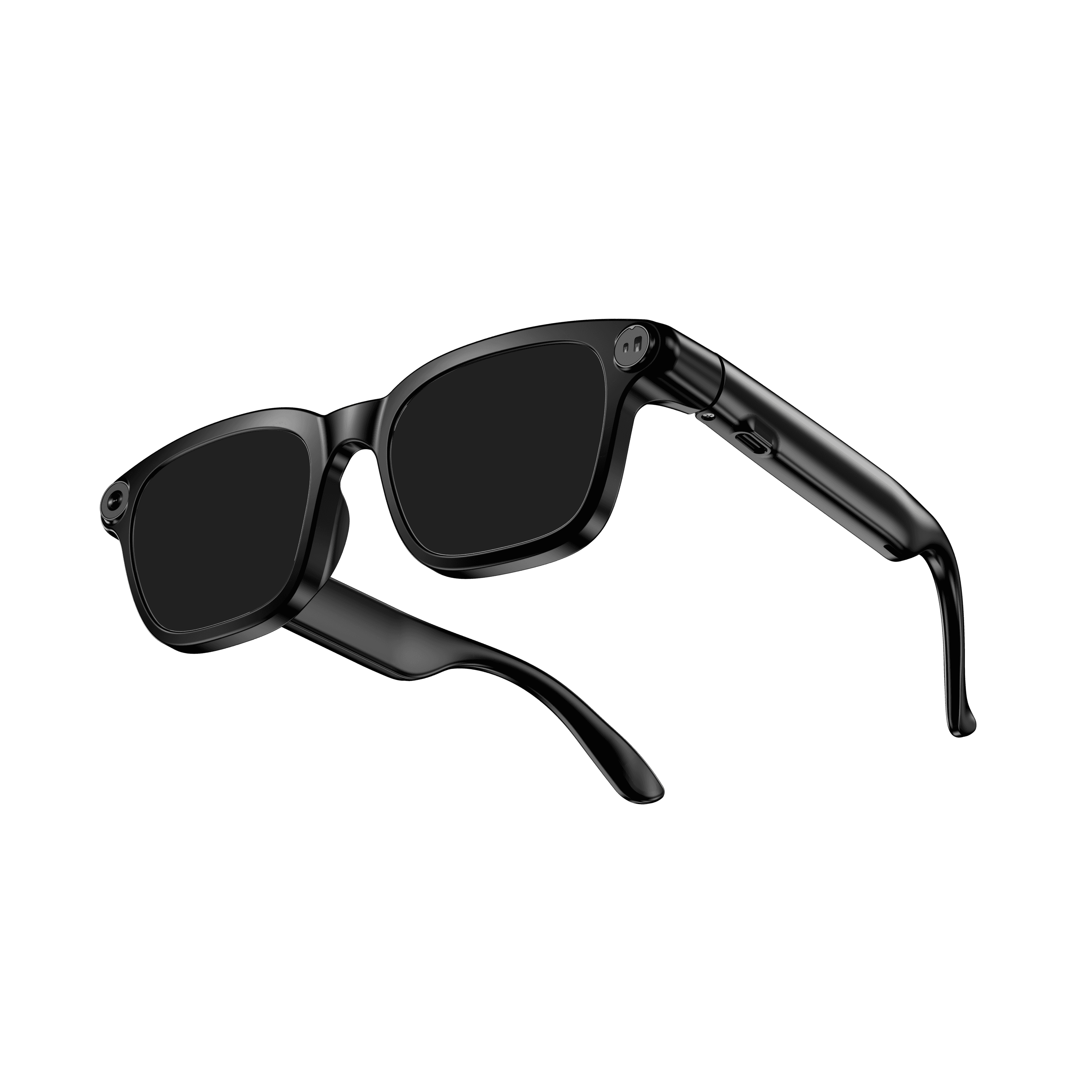 OXIVUE M08$99 at checkout | 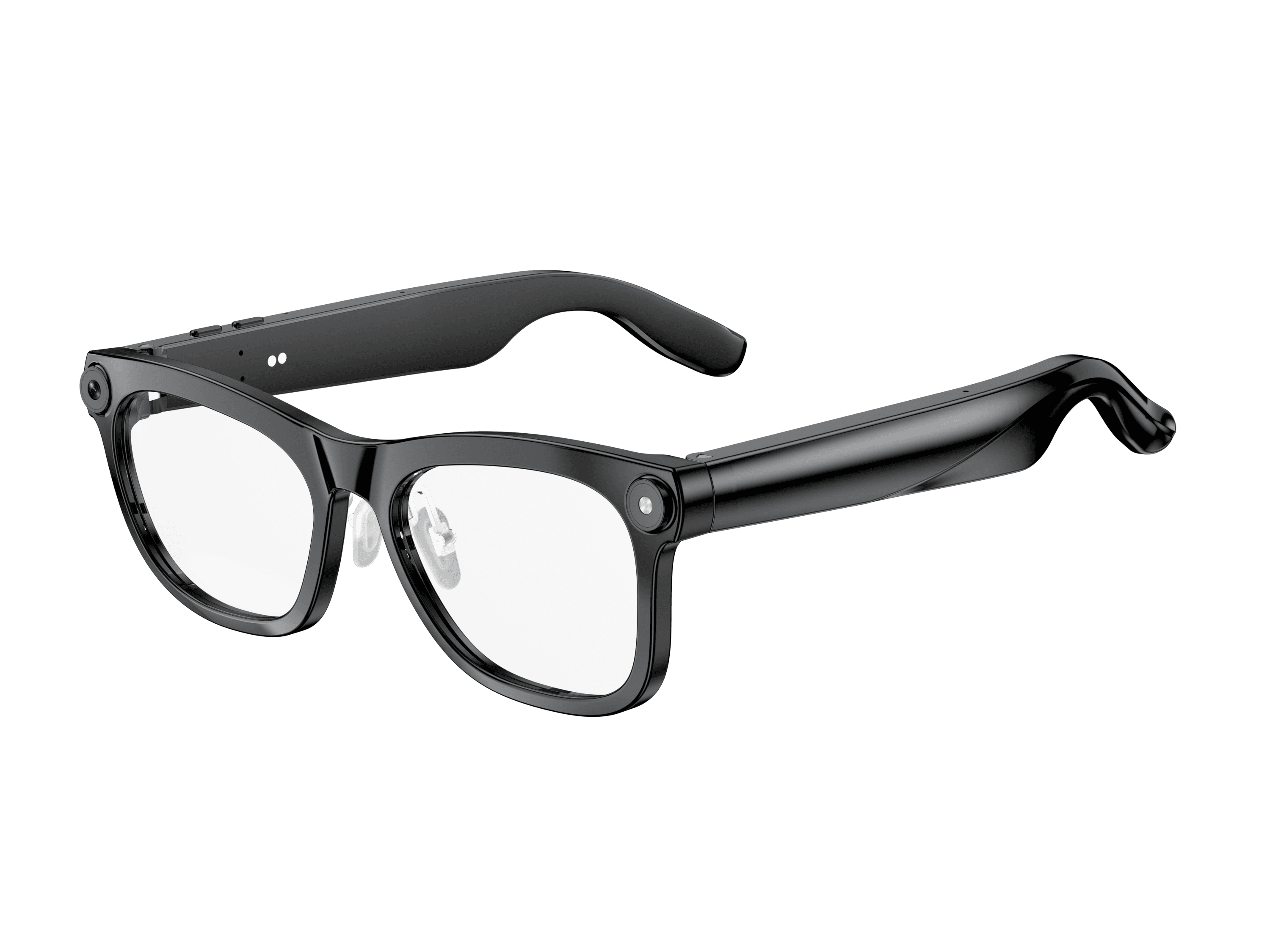 OXIVUE M02C$109 at checkout | |
|---|---|---|
| Camera | 8 MP | 8 MP |
| Weight | ~42 g | ~41 g |
| Water rating | — | IP65 |
| Lenses | Sunglasses · Photochromic · Clear | Sunglasses · Photochromic · Clear |
| Translation | 40+ languages | 40+ languages |
| Visual AI | — | Yes |
From each frame’s product page. Every model: open-ear audio, Bluetooth 5.4, no subscription. Full spec table
What these frames won’t do
- No prescription lenses yet, on any model. If you need vision correction all day, these can't replace your glasses.
- No display. Nothing appears in your view; you hear answers and capture photos and video.
- Open-ear speakers leak some sound at high volume and won't block out a loud train or a windy road the way sealed earbuds do.
- Translation, music, calls and the assistant need your phone nearby and connected. Translation pauses after each sentence, and only you hear the translated audio; the other person reads the reply on your phone.
- M08: no published water rating, so keep it out of heavy rain and spray.
- M02C: IP65 resists dust and water jets, not immersion. No swimming, no saltwater.
Check these before you order: see the warranty and refund policy.