AR glasses · Display tech · 2026
Augmented glasses, or AR glasses: what exists, what it costs, where the limits are
Augmented glasses are meant to put digital content on top of the world you are looking through. In practice the AR label covers very different products: screen-first display glasses priced from $249 to $599, a $1,299 standalone pair, display smart glasses, and a prototype Meta says is not coming to consumers. This guide sorts them using the makers' own pages, checked October 31, 2026.
Still deciding? Get the M02C, M08 and M08C comparison in your inbox, with your new-customer price already applied.
One email with the comparison, one follow-up a few days later. Unsubscribe any time.
1. What are augmented glasses? Start with the makers’ own words
Augmented glasses overlay digital content on the physical world you see through the lenses. Magic Leap’s site (checked October 31, 2026) describes “see-through augmented reality” through waveguides and display systems, and says its waveguide technology delivers “precise digital content overlayed on top of the physical world.” Meta, introducing its Orion prototype (September 25, 2024; checked October 31, 2026), says AR glasses can offer “digital experiences that are unconstrained by the limits of a smartphone screen,” and that true AR glasses combine “the benefits of a large holographic display and personalized AI assistance.”
Turn those definitions into a checklist and three questions fall out. Can you see the real world through the lenses? Does the digital content stay put in the room instead of riding with your head, which needs tracking? Is the picture big enough to matter? Those tests are ours, not an industry standard, and the rest of this guide applies them to what was available to buy on October 31, 2026.
The label is used loosely. XREAL’s page quotes a review that describes the XREAL One Pro as “AR glasses” (an unattributed excerpt). VITURE’s home page tags its Luma Ultra “Performance & AR”. RayNeo’s store labels its GT and Air models “AR Glasses” (all checked October 31, 2026). Meta, in contrast, files Meta Ray-Ban Display as “Display AI glasses” in its launch article and keeps “true augmented reality glasses” for Orion, a “product prototype”.
That gap is why the search results for augmented glasses look so mixed. On October 31, 2026 Google showed VITURE’s own ranking of AR glasses, Magic Leap’s company page, a CNET smart-glasses roundup dated April 29, 2026, videos, and eBay and Amazon listings. If you are still sorting AI glasses from smart glasses from AR glasses, start with our AI glasses vs. smart glasses vs. AR glasses guide; this page goes deeper on the display end.
2. Are augmented reality glasses real? Four kinds you can find
Yes, but only some kinds can be bought, and the prices on the makers’ own pages run from $249 to $1,299. The table sorts what we found on October 31, 2026 by what the glasses actually do.
| Kind | Examples and displayed prices | What it is, per the maker |
|---|---|---|
| Screen-first display glasses | XREAL Air 2 Pro $249, XREAL One $399, XREAL One Pro $539. VITURE Pro 2 $299, Luma $399, Luma Pro $499, Luma Ultra $599. RayNeo Air 3s $269, Air 4 Pro from $299, GT $329, GT Max $429 | A large virtual screen. XREAL says its spatial screen works “when connected to devices with USB-C” |
| Standalone AI+AR glasses | RayNeo X3 Pro $1,299 | Full-color MicroLED, binocular diffractive waveguide, 30° field of view, 76 g, “6DoF + SLAM” in Creator Mode |
| Display smart glasses | Meta Ray-Ban Display, announced from $799 with the Meta Neural Band. Even G2 from $599. RayNeo iO from $499 | A display built into the lens. Meta files its pair as “Display AI glasses”; Even calls the G2 “smart glasses with a display”; RayNeo’s tagline for the iO is “Invisible AI Display for Everyday Productivity” |
| Prototype or supplier | Meta Orion, a prototype. Magic Leap, no product or price on its home page | Meta: “won’t make its way into the hands of consumers.” Magic Leap: teams “guide partners through every phase of AR glasses development” |
Prices checked October 31, 2026, as each maker displayed them.They change often, and XREAL’s page showed more than one price for the One Pro (the $539 above is the one in its compare table), so confirm on the maker’s site before ordering. Meta’s $799 comes from its September 17, 2025 launch article; meta.com did not load for us, so check it for the current price.
3. Screen-first display glasses: XREAL, VITURE and RayNeo’s Air line
Screen-first display glasses start at $249 on the pages we checked, and they are screens first. XREAL’s compare table (checked October 31, 2026) lists three models side by side: the XREAL One Pro with “X Prism” optics, a 57° field of view, 87 g and $539; the XREAL One with “Birdbath optics”, 50°, 82 g and $399; and the Air 2 Pro at 46°, 75 g and $249. The plain Air 2 was not in that table.
For tracking, the One Pro page offers a “native 3 DoF spatial screen”, meaning the picture can hold still as you turn your head, and lists 6 DoF as “Supported, eye Required”, which appears to refer to the separate XREAL Eye camera accessory the page also describes. The page describes a 0.55-inch Sony micro-OLED, up to 120 Hz and a virtual screen of up to 171 inches. Its listing does not mention a built-in camera.
VITURE’s home page lists the Pro 2 at $299 up to the Luma Ultra and Phantom Beast at $599, mentions Android, iPhone, Nintendo Switch 2, Steam Deck, Mac and Windows devices, and gave no field-of-view figure we could use. RayNeo’s store describes the GT as “Native 3DoF for Travel & Everyday Viewing” and the GT Max as a 267-inch cinema display for movies and gaming, and likewise gave no field of view.
The pages we read describe movies, games and a large virtual screen from a connected device. If that is the job, these are built for it; our XREAL alternatives and RayNeo alternatives guides explain how a display pair differs from camera glasses.
4. Standalone AR glasses and prototypes
The standalone pair we checked is the RayNeo X3 Pro, listed at $1,299 with full specs on its maker’s page. RayNeo calls it “AI+AR” and lists a “Full-Color MicroLED” display through a “Binocular Diffractive Waveguide”, a 30° field of view, 76 g (plus or minus 1 g), a Sony IMX681 12 MP main camera plus a spatial camera, a 245 mAh battery with a full charge in about 38 minutes “under specified conditions”, and “6DoF + SLAM support” in its Creator Mode. Set the 30° against the 57° on XREAL’s One Pro: each maker’s own figure puts the X3 Pro’s field of view below the One Pro’s.
The pair Meta calls “true augmented reality glasses” is not for consumers, by Meta’s account. Orion is a “product prototype”; Meta says it “won’t make its way into the hands of consumers” and that access goes to “Meta employees and select external audiences.” Its September 2025 Ray-Ban Display launch article adds that Meta is “continuing to work on a consumer version” of Orion. Meta gives no field-of-view number, only the “largest field of view in the smallest AR glasses form to date.” Magic Leap’s home page (checked October 31, 2026) presents the company around waveguides and AR glasses development and shows no consumer product or price.
More is coming, without dates. Google’s Android XR page (checked October 31, 2026) lists its display glasses as “Stay tuned” with no date and says the first collections of audio glasses are “launching this fall”. It also shows XREAL AURA, “wired XR glasses powered by Android”, with a Buy now button and no price on that page.
5. Display smart glasses: Meta Ray-Ban Display and Even G2
Display smart glasses build a display into the lens of everyday-style frames. Meta’s launch article (checked October 31, 2026) lists “Augmented reality glasses”, like the Orion prototype, as a separate category from Meta Ray-Ban Display, and Even’s pages describe the G2 without the words “augmented reality”. Meta’s article announces Meta Ray-Ban Display from $799, including the Meta Neural Band wristband, with “a full-color, high-resolution display that’s there when you want it — and gone when you don’t.” It gives up to six hours of mixed-use battery and up to 30 hours in total, and 18 hours for the band. It gives no field-of-view or resolution figure. Our Meta Ray-Ban Display guide goes through the screen, the wristband and who it suits.
Even Realities’ store lists the Even G2 from $599. Its specs page describes waveguides with a Micro LED display, a green display at 640 by 350 and a 27.5° field of view, and says “Just 36 grams”, “Camera-free. By design.” and up to two days of battery. It offers custom lenses from -12.00 to +12.00. For where these sit among all display types, see smart glasses with a display.
6. Limits to check before you buy
On the makers’ own numbers, the figures to compare are field of view, cost, weight, battery, prescription options and cameras. Check them before the label persuades you.
- Field of view varies.27.5° (Even G2), 30° (RayNeo X3 Pro), and 46° to 57° on XREAL’s compare table. Meta’s Ray-Ban Display article gives no field of view.
- The standalone pair we checked costs more. $1,299 for the X3 Pro, against $249 to $599 for the screen-first pairs we listed.
- Weight spans a wide range. 36 g for the G2, 75 g to 87 g for the XREAL models and 76 g for the X3 Pro. The OXIVUE M02C, with no display, is about 41 g.
- Battery varies widely.Meta lists up to six hours of mixed use for Ray-Ban Display, Even says up to two days for the G2, and RayNeo lists the X3 Pro’s 245 mAh cell and a 38-minute full charge but, on the page we checked, no runtime in hours.
- Prescription needs a check. Even offers custom lenses from -12.00 to +12.00, and RayNeo lists an iO model with prescription lenses from $658. For the others, ask the maker before you order.
- Cameras differ.The G2 is camera-free, XREAL’s listing does not mention a built-in camera (it describes a separate XREAL Eye camera), and the X3 Pro lists a 12 MP one.
7. Which kind fits which job
There is no overall winner here, because the kinds do different jobs. OXIVUE publishes this page and sells glasses without a display, so weigh section 8 with that in mind.
- A big virtual screen for video, games or a computer. Screen-first display glasses (XREAL, VITURE, RayNeo Air and GT). Compare field of view, weight, the devices each maker lists and the price on its own site.
- Digital content tied to the room, on your face.XREAL lists 6 DoF as “Supported, eye Required”, and RayNeo’s X3 Pro lists 6DoF + SLAM in its Creator Mode, at $1,299 and 30°. Meta says Orion will not reach consumers.
- A display built into everyday-style frames. Display smart glasses: Even G2 from $599, Meta Ray-Ban Display announced from $799.
- A camera, open-ear audio and an assistant, with nothing in your view. That is a different category, covered next.
- Waiting.Google lists display glasses as “Stay tuned” with no date, and Meta says Orion will not reach consumers. Buying now means buying what the pages above describe.
8. Where OXIVUE fits: no display, so not AR
OXIVUE glasses are not augmented reality. None has a display of any kind, none takes prescription lenses and none runs Meta AI. The M02C ($109 at checkout for one pair) has a Sony IMX219 8 MP camera with dual stabilisation, open-ear speakers, a voice-activated visual AI that describes what you are looking at, and translation in 40+ languages through the free companion app. Translated audio is heard only by you, and the other person reads the reply on your phone.
It weighs about 41 g, is rated IP65 (dust and water jets, not immersion), charges through a magnetic pogo connector, and is rated 7 hours of listening and 4 hours of calls. Capture starts only with a touch on the temple, there is no subscription, and you should ask before recording people. If a display is the point, the pairs above are the better fit. If you want an everyday pair that answers questions, takes photos and translates, compare the M02C with the M08 ($99 at checkout) on the comparison page, or browse the eyewear collection.
Shipping, refunds and warranty. Free shipping from $99. US orders typically arrive in 5–9 business days. International orders take 9–14 business days after shipment, and import VAT or duties outside the US are paid by the recipient. No refunds except transit damage (replaced or refunded); faults are repaired or replaced under the 2-year warranty; change of mind and unmet expectations are not refundable. None of our frames take prescription lenses. They have no display either. Read the refund policy, the shipping policy and the warranty.
Frequently asked questions
What do AR glasses mean?
AR glasses are glasses that overlay digital content on the real world you see through the lenses. Magic Leap's site describes "see-through augmented reality" through waveguides and display systems (checked October 31, 2026), and Meta says true AR glasses combine a large holographic display with an AI assistant. Many products sold as AR glasses, such as the XREAL One Pro, are display glasses that show a large virtual screen from a connected device. Before paying, check the optics, the field of view and whether content stays anchored in the room.
Are augmented reality glasses real?
Yes, but the products differ a lot, and Meta says its own true AR pair, Orion, is not coming to consumers. On October 31, 2026 the makers' own pages showed screen-first display glasses from $249 to $599, RayNeo's standalone X3 Pro at $1,299 with 6DoF and SLAM in its creator mode, and display smart glasses from $599 (Even G2) to Meta Ray-Ban Display, announced from $799. Meta's 2024 article says Orion "won't make its way into the hands of consumers", and its 2025 launch article says it is working on a consumer version.
How much does the XREAL Air 2 cost?
The Air 2 Pro was $249 on XREAL's compare table on October 31, 2026, and the plain Air 2 was not in that table; it also showed the XREAL One at $399 and the XREAL One Pro at $539. VITURE's home page showed $299 to $599 across its glasses, and RayNeo's store showed $269 (Air 3s) to $429 (GT Max) for models it labels AR glasses, with the X3 Pro at $1,299. These are displayed prices that can change, so confirm on each maker's site.
Are augmented reality glasses worth it?
Yes, if the job is a large virtual screen; for other jobs it depends on the kind. For movies, games or a large virtual screen, display glasses are built for it, and their field of view runs from 46° to 57° on XREAL's compare table. For a display built into everyday-style frames, Even G2 (from $599) and Meta Ray-Ban Display (announced from $799) put one in the lens, at 27.5° for the G2. If you want a camera, voice assistant and translation without a display, the OXIVUE M02C is $109 at checkout, but it is not AR.
Do AR glasses work without a phone or computer?
Only some are described as standalone. XREAL's page (checked October 31, 2026) says its spatial screen works "when connected to devices with USB-C" and does not call the One Pro standalone. RayNeo's X3 Pro page calls it a "standalone AI+AR glasses design" and lists its own battery and a 12 MP camera. Meta says its Orion prototype is not coming to consumers. Confirm what each pair needs on its maker's page before you order.
Is Meta Ray-Ban Display augmented reality?
No, Meta does not put it in its augmented reality category. Meta's launch article (September 17, 2025; checked October 31, 2026) files it as "Display AI glasses" with a full-color display that is "there when you want it", and lists "Augmented reality glasses", like the Orion prototype, as a separate category. It started at $799 including the Meta Neural Band wristband, with up to six hours of mixed-use battery. Meta's Orion article calls that prototype its true AR glasses. Check meta.com for the current price and countries.
Do OXIVUE glasses have AR?
No. OXIVUE frames have no display of any kind, so nothing is overlaid on your view. The M02C ($109 at checkout, one pair) has an 8 MP camera, open-ear audio, a voice-activated visual AI that describes what you look at, and 40+ language translation through the free companion app, with translated audio heard only by you. Capture starts only with a touch on the temple. None of our frames take prescription lenses.
OXIVUE frames side by side
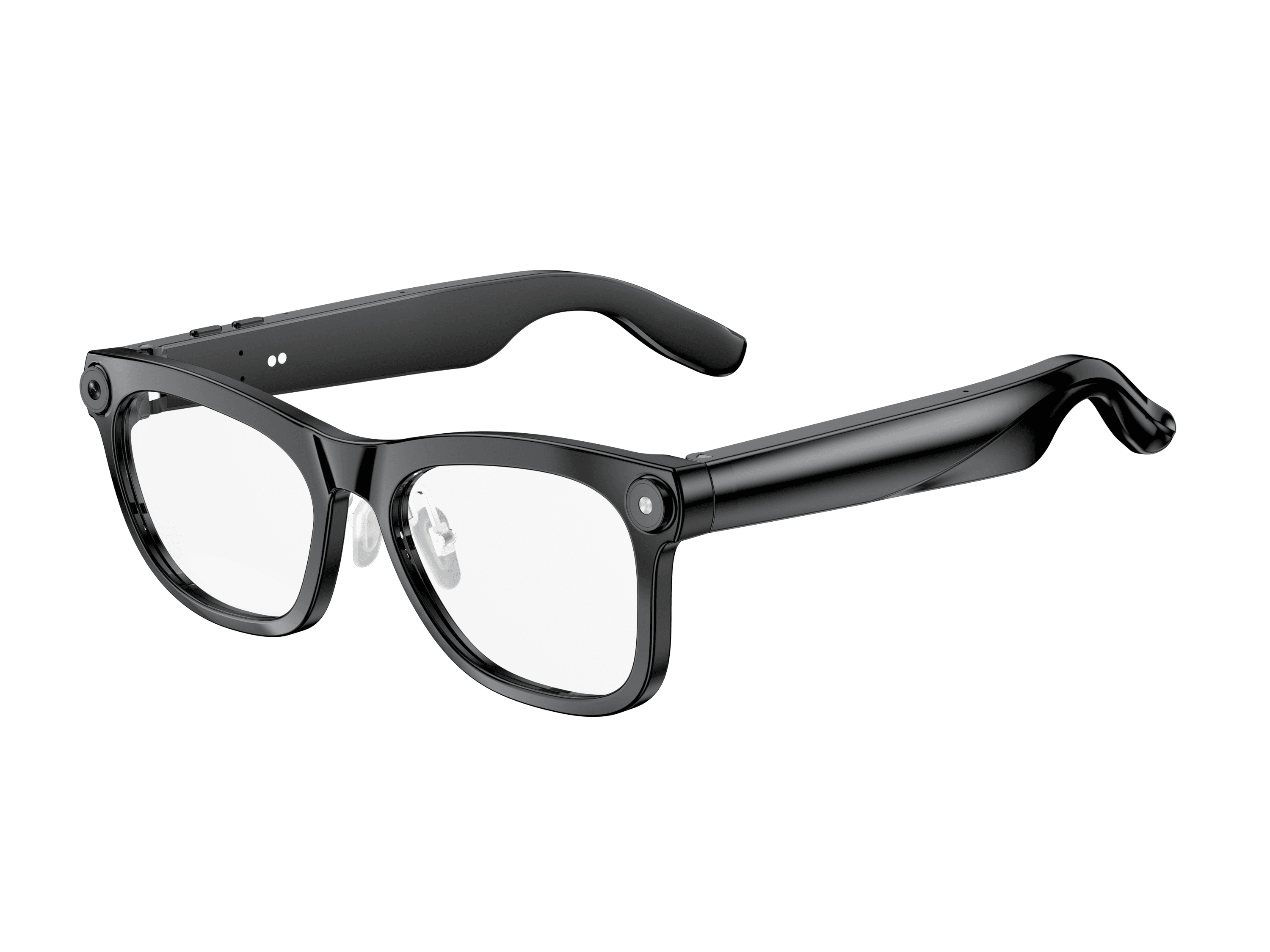 OXIVUE M02C$109 at checkout | 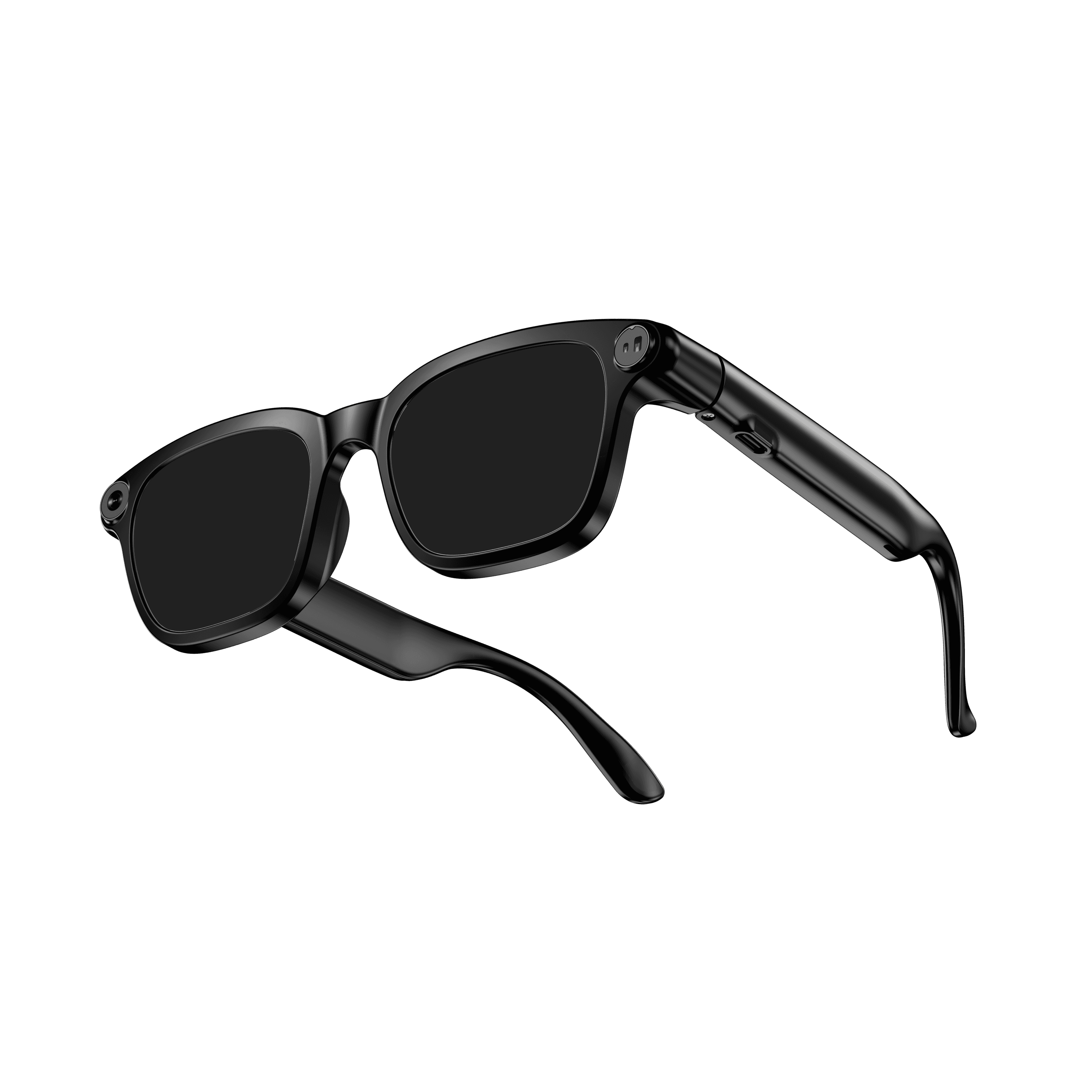 OXIVUE M08$99 at checkout | 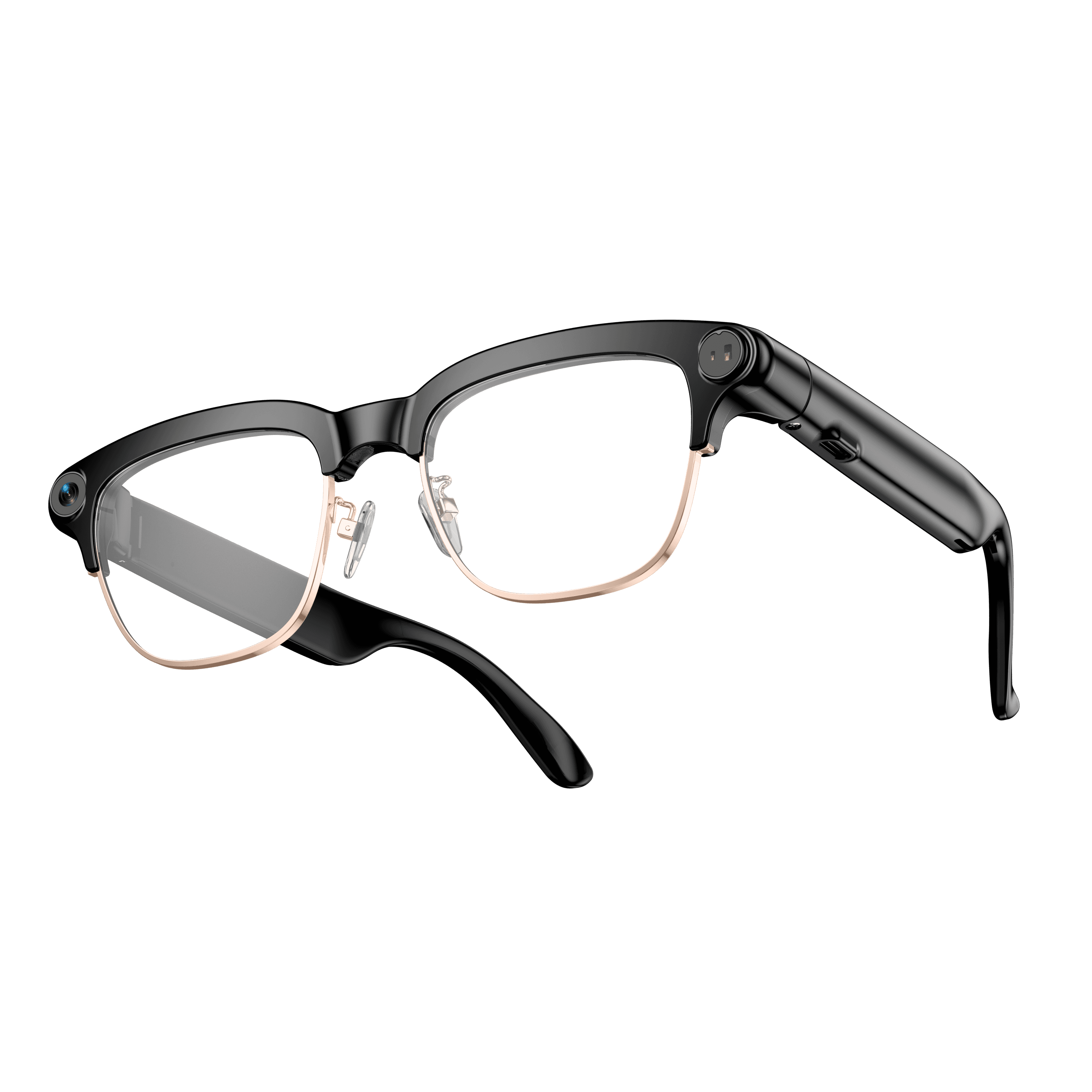 OXIVUE M08C$119 at checkout | |
|---|---|---|---|
| Camera | 8 MP | 8 MP | 8 MP |
| Weight | ~41 g | ~42 g | ~42 g |
| Water rating | IP65 | — | — |
| Lenses | Sunglasses · Photochromic · Clear | Sunglasses · Photochromic · Clear | Sunglasses · Photochromic · Clear |
| Translation | 40+ languages | 40+ languages | 40+ languages |
| Visual AI | Yes | — | — |
| Metal trim | — | — | Gold · Silver |
From each frame’s product page. Every model: open-ear audio, Bluetooth 5.4, no subscription. Full spec table
What these frames won’t do
- No prescription lenses yet, on any model. If you need vision correction all day, these can't replace your glasses.
- No display. Nothing appears in your view; you hear answers and capture photos and video.
- Open-ear speakers leak some sound at high volume and won't block out a loud train or a windy road the way sealed earbuds do.
- Translation, music, calls and the assistant need your phone nearby and connected. Translation pauses after each sentence, and only you hear the translated audio; the other person reads the reply on your phone.
- M02C: IP65 resists dust and water jets, not immersion. No swimming, no saltwater.
Check these before you order: see the warranty and refund policy.